
Largest Martian Meteorite Fetches $5.3 Million at Sotheby's Auction
In This Article
HIGHLIGHTS
- The largest Martian meteorite ever found on Earth, NWA 16788, sold for $4.3 million at a Sotheby's auction in New York.
- The meteorite, weighing 54 pounds, was discovered in Niger in November 2023 and is 70% larger than the next largest piece of Mars.
- Including fees, the total cost of the meteorite reached approximately $5.3 million, though the buyer's identity remains undisclosed.
- Only about 400 Martian meteorites have been found on Earth, making this a rare geological object.
- The auction also featured a Ceratosaurus skeleton, which sold for $26 million, highlighting the event's focus on rare finds.
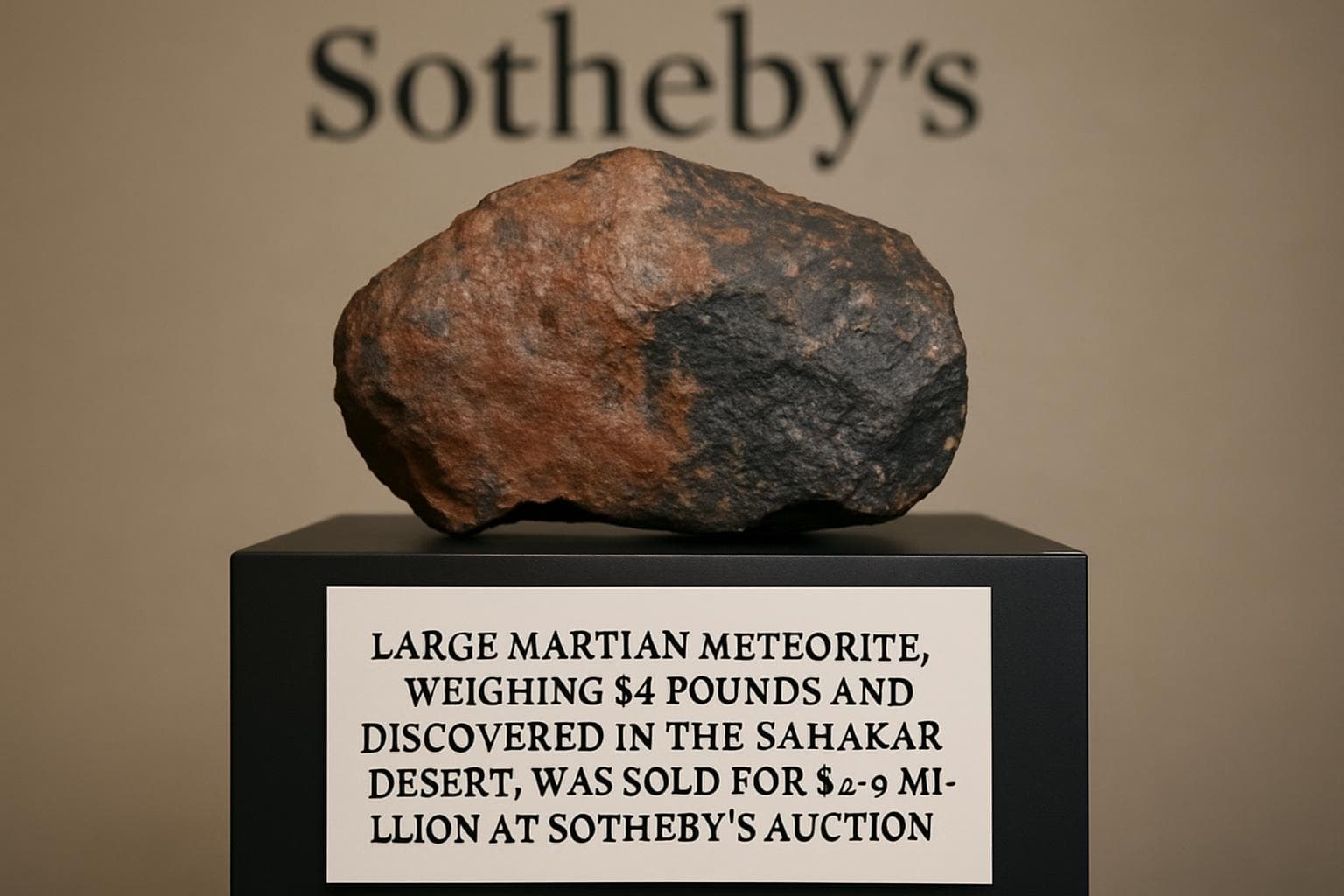
In a remarkable event at Sotheby's auction house in New York, the largest Martian meteorite ever discovered on Earth was sold for $4.3 million, with additional fees bringing the total to $5.3 million. Known as NWA 16788, this extraordinary piece of Mars was found in the Sahara Desert in Niger in November 2023. Weighing 54 pounds and measuring nearly 15 inches in length, the meteorite is 70% larger than any other Martian rock found on Earth.
Discovery and Significance
The meteorite's journey from Mars to Earth is a testament to the wonders of space. Blasted off the Martian surface by a massive asteroid strike, it traveled approximately 140 million miles before landing on our planet. Cassandra Hatton, vice-chairman of science and natural history at Sotheby's, emphasized the rarity of such a find, noting that only about 400 Martian meteorites have been discovered globally. "The odds of this getting from there to here are astronomically small," Hatton remarked.
Auction Highlights
The auction, which featured over 100 rare geological and archaeological items, saw the Martian meteorite as one of its star attractions. Despite the high interest, the bidding process was slower than anticipated, with the auctioneer reducing bid intervals to encourage more offers. The identity of the buyer remains private, adding an air of mystery to the sale.
Scientific Insights
The meteorite, classified as an "olivine-microgabbroic shergottite," offers valuable scientific insights. Its coarse-grained texture and glassy surface, a result of high heat during its atmospheric entry, were key indicators of its Martian origin. A specialized lab confirmed its provenance by comparing its chemical composition with Martian samples from the Viking spacecraft missions.
Other Notable Sales
The auction also featured a juvenile Ceratosaurus skeleton, which fetched $26 million, underscoring the event's focus on rare and significant finds. These sales highlight the growing interest and value placed on unique geological and paleontological specimens.
WHAT THIS MIGHT MEAN
The sale of NWA 16788 underscores the increasing fascination with space and extraterrestrial materials. As private collectors and institutions vie for such rare objects, the market for meteorites and other space-related artifacts is likely to grow. This trend could spur further scientific research and exploration, potentially leading to new discoveries about Mars and other celestial bodies. Additionally, the anonymity of the buyer raises questions about the future display and study of this significant Martian rock, which could influence public access to such rare finds.
Related Articles

Niger Airport Attack Sparks Tensions with France and Regional Neighbors

Prince Andrew's Ties to Epstein Under Scrutiny Amid Calls for Inquiry

Antonia Romeo Appointed as First Female UK Cabinet Secretary Amid Controversy

Indian National Pleads Guilty in US Murder-for-Hire Plot Targeting Sikh Activist

Luigi Mangione's State Trial Set for June Amid Double Jeopardy Concerns

Global Counsel CEO Resigns Amid Epstein File Revelations
Largest Martian Meteorite Fetches $5.3 Million at Sotheby's Auction
In This Article
 James Okoro| Published
 HIGHLIGHTS
- The largest Martian meteorite ever found on Earth, NWA 16788, sold for $4.3 million at a Sotheby's auction in New York.
- The meteorite, weighing 54 pounds, was discovered in Niger in November 2023 and is 70% larger than the next largest piece of Mars.
- Including fees, the total cost of the meteorite reached approximately $5.3 million, though the buyer's identity remains undisclosed.
- Only about 400 Martian meteorites have been found on Earth, making this a rare geological object.
- The auction also featured a Ceratosaurus skeleton, which sold for $26 million, highlighting the event's focus on rare finds.
In a remarkable event at Sotheby's auction house in New York, the largest Martian meteorite ever discovered on Earth was sold for $4.3 million, with additional fees bringing the total to $5.3 million. Known as NWA 16788, this extraordinary piece of Mars was found in the Sahara Desert in Niger in November 2023. Weighing 54 pounds and measuring nearly 15 inches in length, the meteorite is 70% larger than any other Martian rock found on Earth.
Discovery and Significance
The meteorite's journey from Mars to Earth is a testament to the wonders of space. Blasted off the Martian surface by a massive asteroid strike, it traveled approximately 140 million miles before landing on our planet. Cassandra Hatton, vice-chairman of science and natural history at Sotheby's, emphasized the rarity of such a find, noting that only about 400 Martian meteorites have been discovered globally. "The odds of this getting from there to here are astronomically small," Hatton remarked.
Auction Highlights
The auction, which featured over 100 rare geological and archaeological items, saw the Martian meteorite as one of its star attractions. Despite the high interest, the bidding process was slower than anticipated, with the auctioneer reducing bid intervals to encourage more offers. The identity of the buyer remains private, adding an air of mystery to the sale.
Scientific Insights
The meteorite, classified as an "olivine-microgabbroic shergottite," offers valuable scientific insights. Its coarse-grained texture and glassy surface, a result of high heat during its atmospheric entry, were key indicators of its Martian origin. A specialized lab confirmed its provenance by comparing its chemical composition with Martian samples from the Viking spacecraft missions.
Other Notable Sales
The auction also featured a juvenile Ceratosaurus skeleton, which fetched $26 million, underscoring the event's focus on rare and significant finds. These sales highlight the growing interest and value placed on unique geological and paleontological specimens.
WHAT THIS MIGHT MEAN
The sale of NWA 16788 underscores the increasing fascination with space and extraterrestrial materials. As private collectors and institutions vie for such rare objects, the market for meteorites and other space-related artifacts is likely to grow. This trend could spur further scientific research and exploration, potentially leading to new discoveries about Mars and other celestial bodies. Additionally, the anonymity of the buyer raises questions about the future display and study of this significant Martian rock, which could influence public access to such rare finds.
Related Articles
Niger Airport Attack Sparks Tensions with France and Regional Neighbors
Prince Andrew's Ties to Epstein Under Scrutiny Amid Calls for Inquiry
Antonia Romeo Appointed as First Female UK Cabinet Secretary Amid Controversy
Indian National Pleads Guilty in US Murder-for-Hire Plot Targeting Sikh Activist
Luigi Mangione's State Trial Set for June Amid Double Jeopardy Concerns
Global Counsel CEO Resigns Amid Epstein File Revelations