
Barclays Fined £42 Million for Financial Crime Risk Management Failures
In This Article
HIGHLIGHTS
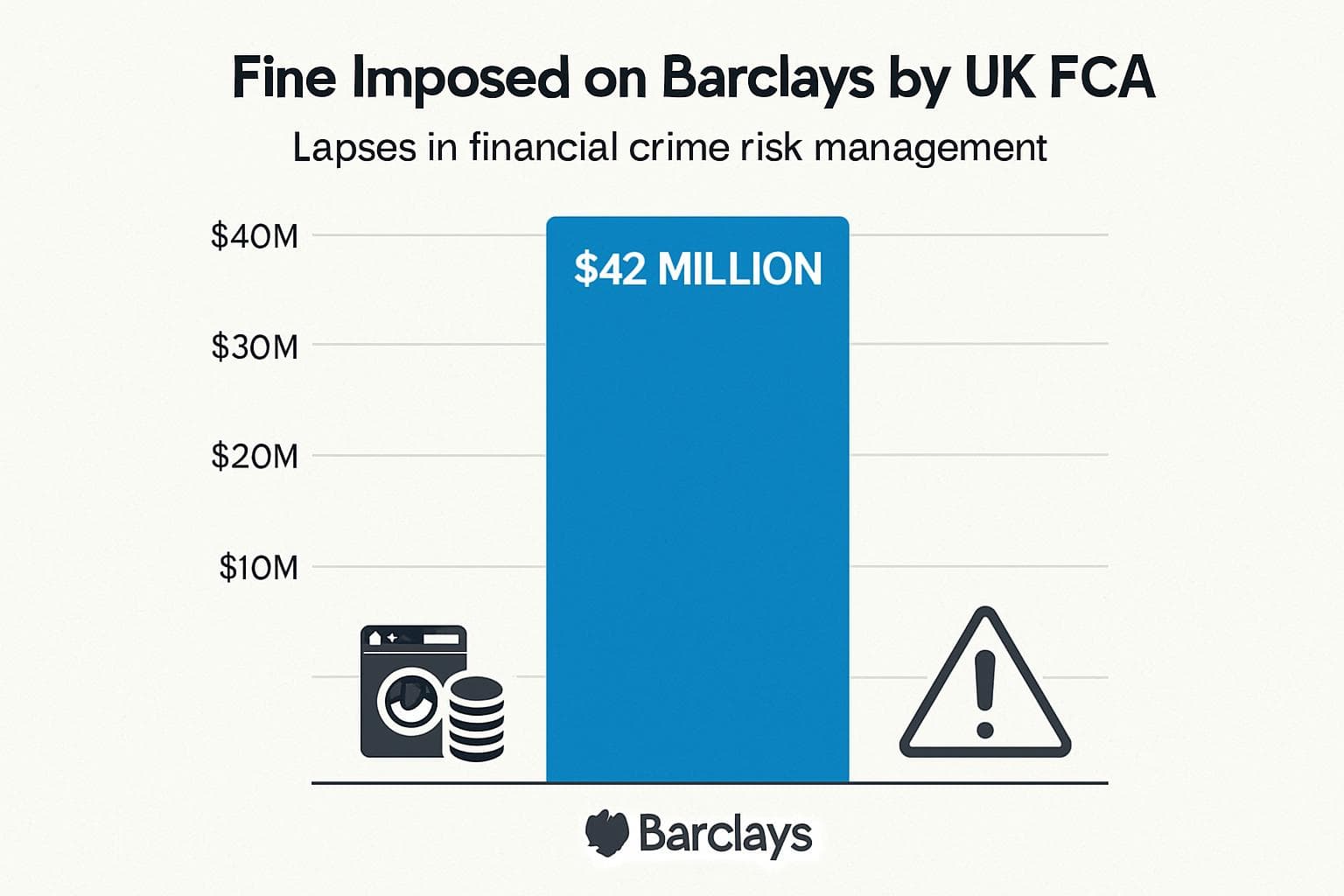
- Barclays Bank has been fined £42 million by the Financial Conduct Authority (FCA) for lapses in financial crime risk management.
- The fine includes £39.3 million related to Stunt & Co and £3.1 million for WealthTek, highlighting Barclays' failure to manage money laundering risks.
- The FCA criticized Barclays for not conducting adequate checks on WealthTek, which was not authorized to hold client money.
- Barclays received a reduced fine due to its cooperation with the FCA and voluntary payments to affected clients.
- The bank has been fined twice before for similar failings in financial crime controls, with previous fines in 2015 and 2022.
Barclays Bank has been hit with a £42 million fine by the UK's Financial Conduct Authority (FCA) for significant lapses in managing financial crime risks. The penalty underscores the bank's failure to adequately vet and monitor its clients, Stunt & Co and WealthTek, leading to potential money laundering vulnerabilities.
Stunt & Co and WealthTek Failures
The FCA's investigation revealed that Barclays failed to manage money laundering risks effectively, resulting in a £39.3 million fine related to its dealings with Stunt & Co. The firm, associated with socialite James Stunt, received £46.8 million from Fowler Oldfield, a known money laundering operation. Barclays only reviewed its exposure to Fowler Oldfield after the FCA's decision to prosecute NatWest for similar issues.
Additionally, Barclays was fined £3.1 million for its inadequate checks on WealthTek, a wealth management company. The FCA noted that a simple review of the Financial Services Register would have shown that WealthTek was not authorized to hold client money. John Dance, a principal partner at WealthTek, faces multiple criminal charges, including money laundering and fraud, with a trial set for September 2027.
Barclays' Response and Previous Fines
Barclays has acknowledged its shortcomings and emphasized its commitment to combating financial crime. The bank cooperated extensively with the FCA's investigation, leading to a reduced fine and voluntary payments to affected clients. This is not the first time Barclays has faced penalties for similar issues; it was fined £72 million in 2015 and £783,800 in 2022 for failing to minimize financial crime risks.
Therese Chambers, joint executive director of enforcement and market oversight at the FCA, stressed the importance of robust financial crime controls, stating, "The consequences of poor financial crime controls are very real – they allow criminals to launder the proceeds of their crimes, and they allow fraudsters to defraud consumers."
WHAT THIS MIGHT MEAN
The hefty fine imposed on Barclays highlights the ongoing challenges banks face in managing financial crime risks. Moving forward, Barclays will likely need to enhance its compliance and monitoring systems to prevent similar issues. The case also serves as a warning to other financial institutions about the importance of rigorous client vetting and adherence to regulatory standards.
The upcoming trial of John Dance could further illuminate the extent of WealthTek's involvement in financial crimes, potentially leading to more stringent regulatory measures. As financial crime remains a significant concern, the FCA's actions may prompt a broader industry-wide review of compliance practices, ensuring that banks prioritize the prevention of money laundering and fraud.
Related Articles
UK Achieves Record Budget Surplus Amid Calls for Fiscal Policy Reform

Breakthrough Drug Offers Hope for Children with Severe Epilepsy

Trump Raises Import Tariffs to 15% After Supreme Court Setback

Arrest of Andrew Mountbatten-Windsor Captured in Iconic Photograph

UK Denies US Use of Military Bases for Potential Iran Strikes Amid Chagos Islands Dispute

Andrew Mountbatten-Windsor Arrested Amid Misconduct Allegations
Barclays Fined £42 Million for Financial Crime Risk Management Failures
In This Article
 Daniel Rivera| Published
 HIGHLIGHTS
- Barclays Bank has been fined £42 million by the Financial Conduct Authority (FCA) for lapses in financial crime risk management.
- The fine includes £39.3 million related to Stunt & Co and £3.1 million for WealthTek, highlighting Barclays' failure to manage money laundering risks.
- The FCA criticized Barclays for not conducting adequate checks on WealthTek, which was not authorized to hold client money.
- Barclays received a reduced fine due to its cooperation with the FCA and voluntary payments to affected clients.
- The bank has been fined twice before for similar failings in financial crime controls, with previous fines in 2015 and 2022.
Barclays Bank has been hit with a £42 million fine by the UK's Financial Conduct Authority (FCA) for significant lapses in managing financial crime risks. The penalty underscores the bank's failure to adequately vet and monitor its clients, Stunt & Co and WealthTek, leading to potential money laundering vulnerabilities.
Stunt & Co and WealthTek Failures
The FCA's investigation revealed that Barclays failed to manage money laundering risks effectively, resulting in a £39.3 million fine related to its dealings with Stunt & Co. The firm, associated with socialite James Stunt, received £46.8 million from Fowler Oldfield, a known money laundering operation. Barclays only reviewed its exposure to Fowler Oldfield after the FCA's decision to prosecute NatWest for similar issues.
Additionally, Barclays was fined £3.1 million for its inadequate checks on WealthTek, a wealth management company. The FCA noted that a simple review of the Financial Services Register would have shown that WealthTek was not authorized to hold client money. John Dance, a principal partner at WealthTek, faces multiple criminal charges, including money laundering and fraud, with a trial set for September 2027.
Barclays' Response and Previous Fines
Barclays has acknowledged its shortcomings and emphasized its commitment to combating financial crime. The bank cooperated extensively with the FCA's investigation, leading to a reduced fine and voluntary payments to affected clients. This is not the first time Barclays has faced penalties for similar issues; it was fined £72 million in 2015 and £783,800 in 2022 for failing to minimize financial crime risks.
Therese Chambers, joint executive director of enforcement and market oversight at the FCA, stressed the importance of robust financial crime controls, stating, "The consequences of poor financial crime controls are very real – they allow criminals to launder the proceeds of their crimes, and they allow fraudsters to defraud consumers."
WHAT THIS MIGHT MEAN
The hefty fine imposed on Barclays highlights the ongoing challenges banks face in managing financial crime risks. Moving forward, Barclays will likely need to enhance its compliance and monitoring systems to prevent similar issues. The case also serves as a warning to other financial institutions about the importance of rigorous client vetting and adherence to regulatory standards.
The upcoming trial of John Dance could further illuminate the extent of WealthTek's involvement in financial crimes, potentially leading to more stringent regulatory measures. As financial crime remains a significant concern, the FCA's actions may prompt a broader industry-wide review of compliance practices, ensuring that banks prioritize the prevention of money laundering and fraud.
Related Articles
UK Achieves Record Budget Surplus Amid Calls for Fiscal Policy Reform
Breakthrough Drug Offers Hope for Children with Severe Epilepsy
Trump Raises Import Tariffs to 15% After Supreme Court Setback
Arrest of Andrew Mountbatten-Windsor Captured in Iconic Photograph
UK Denies US Use of Military Bases for Potential Iran Strikes Amid Chagos Islands Dispute
Andrew Mountbatten-Windsor Arrested Amid Misconduct Allegations