
Controversial Board Game on Northern Ireland Troubles Faces Backlash
In This Article
HIGHLIGHTS
- A proposed board game, "The Troubles: Shadow War in Northern Ireland 1964-1998," has sparked controversy for its portrayal of the Northern Ireland conflict.
- The game, developed by Hugh O'Donnell and Compass Games, is still in development and aims to educate players on historical events through role-playing.
- Victims' groups have criticized the game as potentially retraumatizing and minimizing the suffering endured during the Troubles.
- The game involves players taking on roles such as the IRA, British Army, and other factions, using cards and tokens to simulate events.
- Developers assert the game is an academic project intended to foster empathy and understanding of complex historical narratives.
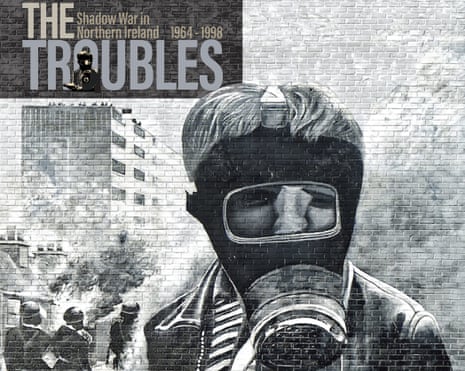
A proposed board game that seeks to simulate the complex and painful history of Northern Ireland's Troubles has ignited a heated debate. Titled "The Troubles: Shadow War in Northern Ireland 1964-1998," the game is the brainchild of Scottish teacher Hugh O'Donnell and is being developed by Compass Games, a Connecticut-based company known for historical games.
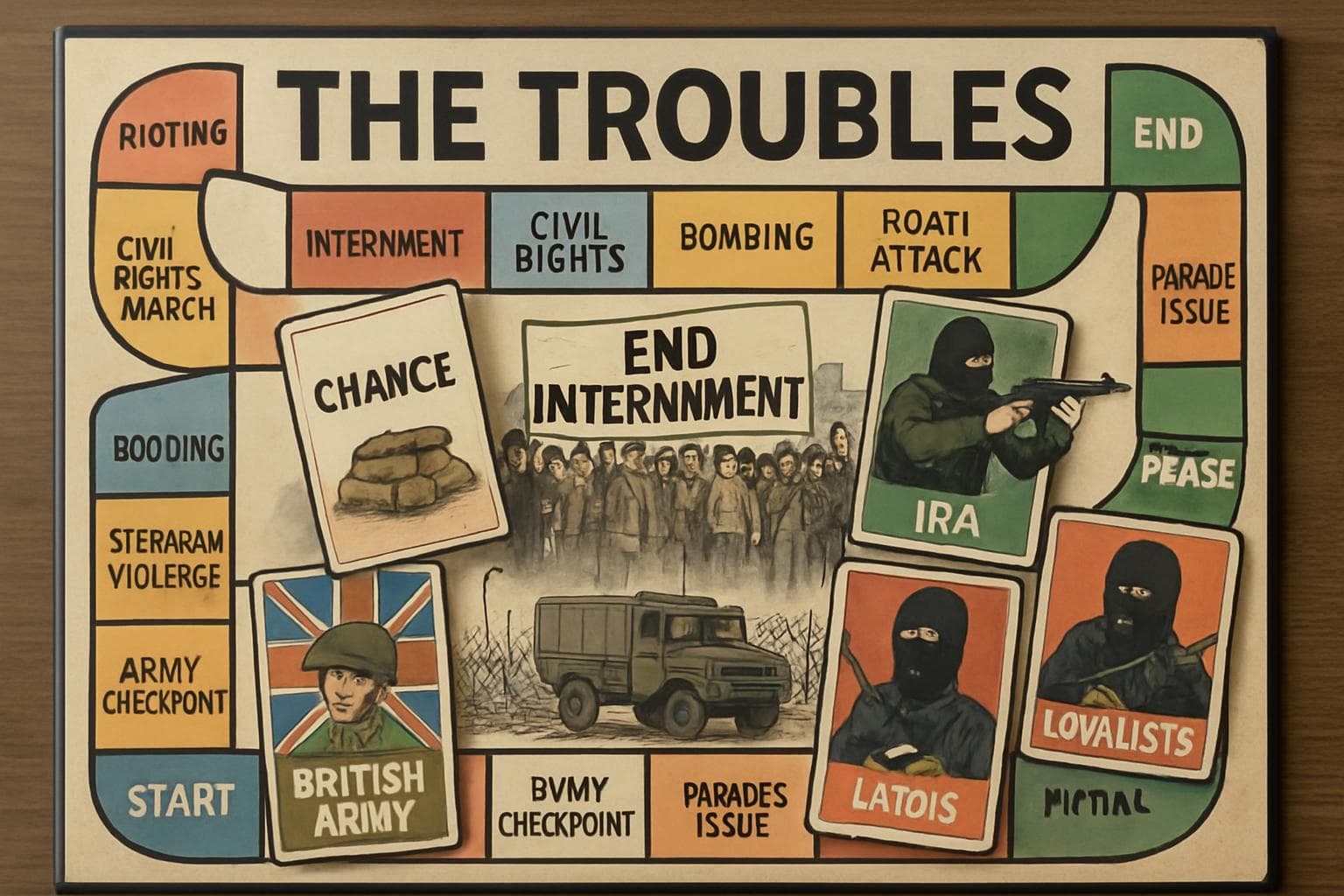
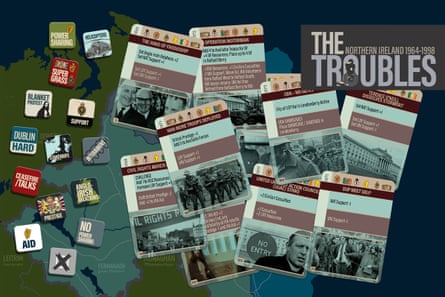
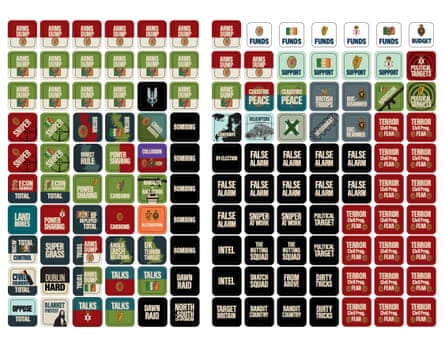
The game, which remains in development and is not yet available for purchase, allows players to assume roles such as unionist or nationalist politicians, the Royal Ulster Constabulary (RUC), or paramilitary groups like the Irish Republican Army (IRA). Through a card-driven simulation, players navigate significant events from the conflict, including the Sunningdale Agreement and the Hunger Strikes, aiming to educate through engagement.
However, the concept has drawn sharp criticism from victims' groups, who argue that the game risks trivializing the suffering endured during the Troubles, a conflict that claimed over 3,500 lives. Kenny Donaldson of the South East Fermanagh Foundation expressed concerns that the game could retraumatize survivors and oversimplify a deeply complex issue. "The Troubles are not past tense," he emphasized, highlighting the ongoing impact on Northern Ireland society.
Despite the backlash, O'Donnell maintains that the project is an interdisciplinary academic endeavor designed to explore how historical board games can foster empathy and engagement with contested narratives. Bill Thomas, president of Compass Games, echoed this sentiment, stating that the game aims to protect history rather than mock it.
The game, which involves extensive rules and over 260 cards, is still undergoing development and playtesting. Its creators stress that it will not be released for several years, allowing time to address concerns and refine its educational approach.
WHAT THIS MIGHT MEAN
The controversy surrounding "The Troubles: Shadow War in Northern Ireland 1964-1998" highlights the delicate balance between education and sensitivity in portraying historical conflicts. As the game continues to develop, its creators face the challenge of addressing the concerns of victims' groups while maintaining the educational intent. Should the game proceed to release, it could set a precedent for how historical events are represented in gaming, potentially influencing future educational tools.
The ongoing dialogue between developers and critics may lead to revisions that better accommodate the sensitivities of those affected by the Troubles. Additionally, this situation underscores the broader conversation about the role of games in education and their capacity to engage with complex historical narratives responsibly.
Images from the Web
Related Articles
MPs Vote to Remove Conditional Immunity for Troubles-Era Crimes

Saharan Dust to Illuminate UK Skies with Vivid Sunrises and Sunsets
Tragedy Strikes County Armagh: Three Dead in Multi-Vehicle Collision
Arctic Blast Brings Snow and Ice Warnings Across the UK
NHS Staff Pay Rise Sparks Union Outrage Amid Inflation Concerns

UK Faces Unprecedented Rainfall as Climate Scientists Call for Urgent Action
Controversial Board Game on Northern Ireland Troubles Faces Backlash
In This Article
 Alex Carter| Published
 HIGHLIGHTS
- A proposed board game, "The Troubles: Shadow War in Northern Ireland 1964-1998," has sparked controversy for its portrayal of the Northern Ireland conflict.
- The game, developed by Hugh O'Donnell and Compass Games, is still in development and aims to educate players on historical events through role-playing.
- Victims' groups have criticized the game as potentially retraumatizing and minimizing the suffering endured during the Troubles.
- The game involves players taking on roles such as the IRA, British Army, and other factions, using cards and tokens to simulate events.
- Developers assert the game is an academic project intended to foster empathy and understanding of complex historical narratives.
A proposed board game that seeks to simulate the complex and painful history of Northern Ireland's Troubles has ignited a heated debate. Titled "The Troubles: Shadow War in Northern Ireland 1964-1998," the game is the brainchild of Scottish teacher Hugh O'Donnell and is being developed by Compass Games, a Connecticut-based company known for historical games.
The game, which remains in development and is not yet available for purchase, allows players to assume roles such as unionist or nationalist politicians, the Royal Ulster Constabulary (RUC), or paramilitary groups like the Irish Republican Army (IRA). Through a card-driven simulation, players navigate significant events from the conflict, including the Sunningdale Agreement and the Hunger Strikes, aiming to educate through engagement.
However, the concept has drawn sharp criticism from victims' groups, who argue that the game risks trivializing the suffering endured during the Troubles, a conflict that claimed over 3,500 lives. Kenny Donaldson of the South East Fermanagh Foundation expressed concerns that the game could retraumatize survivors and oversimplify a deeply complex issue. "The Troubles are not past tense," he emphasized, highlighting the ongoing impact on Northern Ireland society.
Despite the backlash, O'Donnell maintains that the project is an interdisciplinary academic endeavor designed to explore how historical board games can foster empathy and engagement with contested narratives. Bill Thomas, president of Compass Games, echoed this sentiment, stating that the game aims to protect history rather than mock it.
The game, which involves extensive rules and over 260 cards, is still undergoing development and playtesting. Its creators stress that it will not be released for several years, allowing time to address concerns and refine its educational approach.
WHAT THIS MIGHT MEAN
The controversy surrounding "The Troubles: Shadow War in Northern Ireland 1964-1998" highlights the delicate balance between education and sensitivity in portraying historical conflicts. As the game continues to develop, its creators face the challenge of addressing the concerns of victims' groups while maintaining the educational intent. Should the game proceed to release, it could set a precedent for how historical events are represented in gaming, potentially influencing future educational tools.
The ongoing dialogue between developers and critics may lead to revisions that better accommodate the sensitivities of those affected by the Troubles. Additionally, this situation underscores the broader conversation about the role of games in education and their capacity to engage with complex historical narratives responsibly.
Images from the Web
Related Articles
MPs Vote to Remove Conditional Immunity for Troubles-Era Crimes
Saharan Dust to Illuminate UK Skies with Vivid Sunrises and Sunsets
Tragedy Strikes County Armagh: Three Dead in Multi-Vehicle Collision
Arctic Blast Brings Snow and Ice Warnings Across the UK
NHS Staff Pay Rise Sparks Union Outrage Amid Inflation Concerns
UK Faces Unprecedented Rainfall as Climate Scientists Call for Urgent Action