
Matthew McConaughey Trademarks Iconic Phrase to Combat AI Misuse
In This Article
HIGHLIGHTS
- Matthew McConaughey has trademarked his image and voice, including his iconic phrase "alright, alright, alright," to prevent AI misuse.
- This move marks the first time an actor has used trademark law to protect their likeness from unauthorized AI-generated content.
- McConaughey's legal team aims to establish a clear perimeter around ownership and consent in the AI landscape.
- The actor is an investor in ElevenLabs, a company specializing in AI voice modeling, highlighting his nuanced stance on AI technology.
- The entertainment industry faces growing concerns over AI-generated images and deepfakes, prompting celebrities to seek new forms of protection.
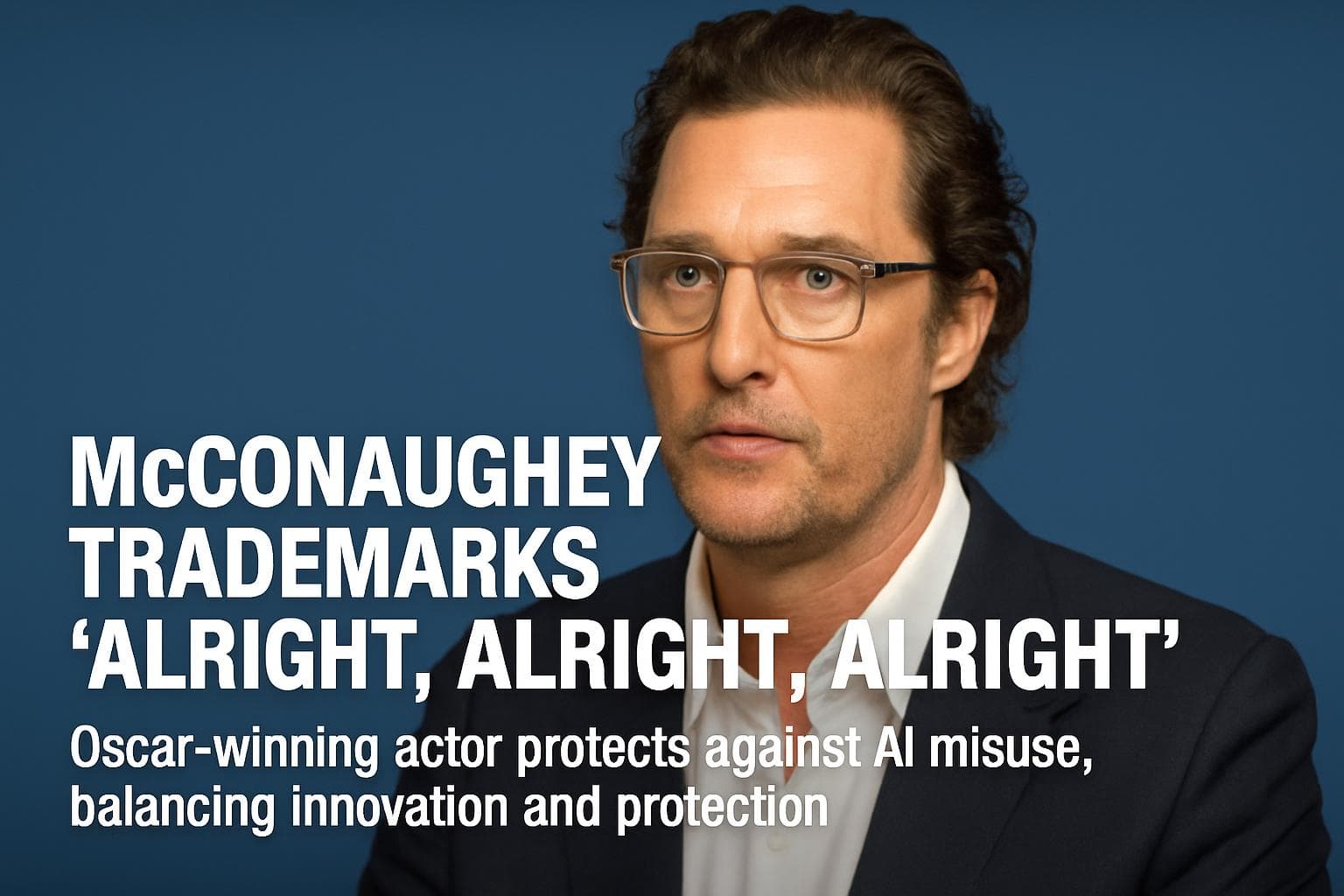
In a pioneering move to safeguard his likeness from unauthorized use by artificial intelligence (AI), Oscar-winning actor Matthew McConaughey has trademarked his image and voice, including his famous catchphrase "alright, alright, alright" from the 1993 film Dazed and Confused. This initiative, reported by the Wall Street Journal, represents the first instance of an actor employing trademark law to shield their identity from AI exploitation.
Protecting Celebrity Likeness in the AI Era
McConaughey's legal team has successfully registered several clips with the United States Patent and Trademark Office, aiming to prevent unauthorized AI-generated content. "My team and I want to know that when my voice or likeness is ever used, it's because I approved and signed off on it," McConaughey stated, emphasizing the importance of consent and attribution in the evolving AI landscape.
The actor's proactive approach comes amid increasing concerns in the entertainment industry about AI misuse. Celebrities like Scarlett Johansson and Taylor Swift have faced challenges with fake video, audio, and images created by AI tools. Legal experts, including Alina Trapova from University College London, note that AI poses significant reputational risks and missed licensing opportunities for stars.
A Nuanced Stance on AI Technology
Despite his protective measures, McConaughey is not entirely opposed to generative AI. He has invested in ElevenLabs, a company specializing in AI voice modeling, and has collaborated with them to create an AI audio version of himself. This dual approach reflects a broader trend among celebrities to balance protection with innovation in the AI domain.
Industry-Wide Implications
The entertainment industry is grappling with the implications of AI-generated content, from digital body scans to non-consensual images. As AI technology advances, the need for robust legal frameworks to protect intellectual property and celebrity likeness becomes increasingly urgent. Dr. Sandra Wachter from the University of Oxford predicts that more creatives will follow McConaughey's lead in seeking legal protection against AI misuse.
WHAT THIS MIGHT MEAN
McConaughey's decision to trademark his likeness could set a precedent for other celebrities seeking to protect their identities in the digital age. As AI technology continues to evolve, legal experts anticipate a surge in similar trademark applications across the entertainment industry. This trend may prompt legislative bodies to consider new regulations addressing AI misuse and intellectual property rights. In the long term, the balance between innovation and protection will be crucial as AI becomes more integrated into creative industries.
Related Articles
Moltbook: The AI-Driven Social Network Sparking Debate
UK Government Considers Social Media Ban for Under-16s Amidst Growing Concerns
Breakthrough Drug Offers Hope for Children with Severe Epilepsy
Trump Sues IRS and US Treasury for $10 Billion Over Tax Return Leaks

Weight-Loss Injections Transform Consumer Habits Amidst Counterfeit Pill Concerns
NHS Tribunal Ruling Sparks Debate Over Transgender Rights and Single-Sex Spaces
Matthew McConaughey Trademarks Iconic Phrase to Combat AI Misuse
In This Article
 Himanshu Kaushik| Published
 HIGHLIGHTS
- Matthew McConaughey has trademarked his image and voice, including his iconic phrase "alright, alright, alright," to prevent AI misuse.
- This move marks the first time an actor has used trademark law to protect their likeness from unauthorized AI-generated content.
- McConaughey's legal team aims to establish a clear perimeter around ownership and consent in the AI landscape.
- The actor is an investor in ElevenLabs, a company specializing in AI voice modeling, highlighting his nuanced stance on AI technology.
- The entertainment industry faces growing concerns over AI-generated images and deepfakes, prompting celebrities to seek new forms of protection.
In a pioneering move to safeguard his likeness from unauthorized use by artificial intelligence (AI), Oscar-winning actor Matthew McConaughey has trademarked his image and voice, including his famous catchphrase "alright, alright, alright" from the 1993 film Dazed and Confused. This initiative, reported by the Wall Street Journal, represents the first instance of an actor employing trademark law to shield their identity from AI exploitation.
Protecting Celebrity Likeness in the AI Era
McConaughey's legal team has successfully registered several clips with the United States Patent and Trademark Office, aiming to prevent unauthorized AI-generated content. "My team and I want to know that when my voice or likeness is ever used, it's because I approved and signed off on it," McConaughey stated, emphasizing the importance of consent and attribution in the evolving AI landscape.
The actor's proactive approach comes amid increasing concerns in the entertainment industry about AI misuse. Celebrities like Scarlett Johansson and Taylor Swift have faced challenges with fake video, audio, and images created by AI tools. Legal experts, including Alina Trapova from University College London, note that AI poses significant reputational risks and missed licensing opportunities for stars.
A Nuanced Stance on AI Technology
Despite his protective measures, McConaughey is not entirely opposed to generative AI. He has invested in ElevenLabs, a company specializing in AI voice modeling, and has collaborated with them to create an AI audio version of himself. This dual approach reflects a broader trend among celebrities to balance protection with innovation in the AI domain.
Industry-Wide Implications
The entertainment industry is grappling with the implications of AI-generated content, from digital body scans to non-consensual images. As AI technology advances, the need for robust legal frameworks to protect intellectual property and celebrity likeness becomes increasingly urgent. Dr. Sandra Wachter from the University of Oxford predicts that more creatives will follow McConaughey's lead in seeking legal protection against AI misuse.
WHAT THIS MIGHT MEAN
McConaughey's decision to trademark his likeness could set a precedent for other celebrities seeking to protect their identities in the digital age. As AI technology continues to evolve, legal experts anticipate a surge in similar trademark applications across the entertainment industry. This trend may prompt legislative bodies to consider new regulations addressing AI misuse and intellectual property rights. In the long term, the balance between innovation and protection will be crucial as AI becomes more integrated into creative industries.
Related Articles
Moltbook: The AI-Driven Social Network Sparking Debate
UK Government Considers Social Media Ban for Under-16s Amidst Growing Concerns
Breakthrough Drug Offers Hope for Children with Severe Epilepsy
Trump Sues IRS and US Treasury for $10 Billion Over Tax Return Leaks
Weight-Loss Injections Transform Consumer Habits Amidst Counterfeit Pill Concerns
NHS Tribunal Ruling Sparks Debate Over Transgender Rights and Single-Sex Spaces