
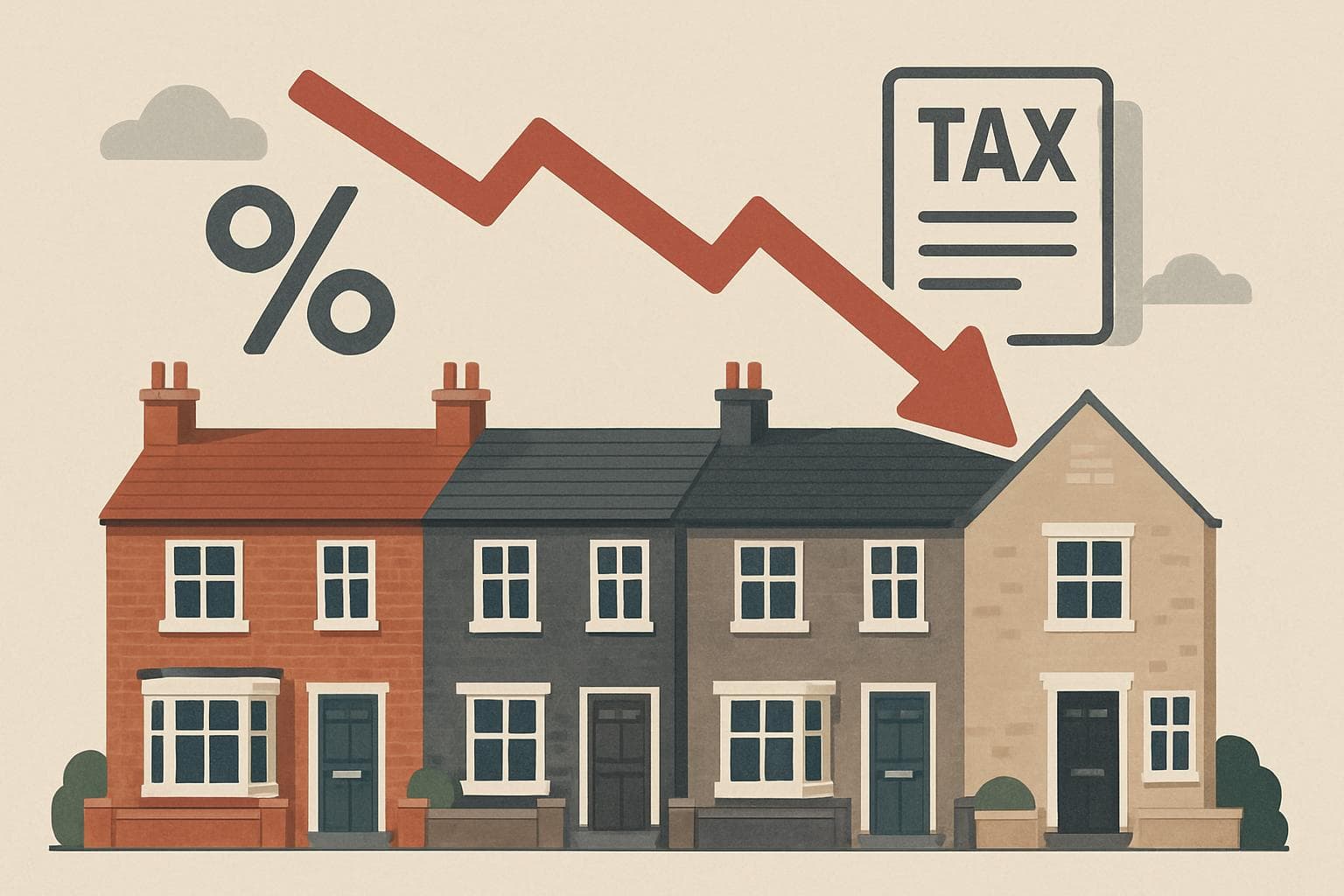
UK House Prices Decline Amid Rising Mortgage Costs and Potential Tax Reforms
In This Article
HIGHLIGHTS
- UK house prices fell by 0.1% in August, with the average home costing £271,079, according to Nationwide.
- Annual house price growth slowed to 2.1% in August, down from 2.4% in July, amid high mortgage costs.
- The UK government is considering property tax reforms, including changes to stamp duty and capital gains tax.
- Nationwide's chief economist highlighted the ongoing affordability challenges due to high house prices and mortgage costs.
- The Bank of England cut the base rate to 4% in August, but mortgage rates remain high, impacting buyer budgets.
UK house prices experienced a slight decline in August, with the average home price dropping by 0.1% to £271,079, according to data from Nationwide Building Society. This unexpected decrease comes as the annual rate of house price growth slowed to 2.1%, down from 2.4% in July, reflecting the impact of high mortgage costs on the housing market.
Mortgage Costs and Affordability Challenges
The decline in house prices is attributed to rising mortgage costs, which have significantly squeezed buyers' budgets. Robert Gardner, chief economist at Nationwide, noted that the cost of servicing a mortgage remains a barrier for many, with average monthly payments for first-time buyers consuming about 35% of their take-home pay. Despite the Bank of England's decision to cut the base rate to 4% in August, mortgage rates remain elevated, with the average two-year fixed rate at 4.96% and five-year deals at 5%.
Potential Property Tax Reforms
In response to the sluggish housing market, the UK government is reportedly considering a series of property tax reforms. These include potential changes to stamp duty, capital gains tax on homes, and the introduction of a national property tax. The proposed reforms aim to stimulate the housing market and address affordability issues, though experts are divided on their potential impact. Some argue that replacing stamp duty could invigorate the market, while others caution about potential revenue losses.
Economic and Political Implications
The possibility of new property taxes, particularly on homes valued above £500,000, has raised concerns about further slowing housing activity, especially in London and the south-east. Elliott Jordan-Doak, a senior economist at Pantheon Macroeconomics, warned that such measures could disrupt the market. Meanwhile, inflationary pressures, with rates rising to 3.8% in July, continue to pose challenges for the broader economy.
WHAT THIS MIGHT MEAN
Looking ahead, the proposed property tax reforms could significantly reshape the UK housing market. If implemented, changes to stamp duty and capital gains tax might ease some affordability pressures but could also lead to short-term market disruptions. The government's decisions in the upcoming autumn budget will be crucial in determining the future trajectory of house prices and market activity.
Economists will be closely monitoring the Bank of England's monetary policy, as further interest rate adjustments could influence mortgage costs and buyer affordability. Additionally, ongoing inflationary pressures may complicate efforts to stabilize the housing market, potentially prompting further fiscal interventions.
Related Articles

Middle East Conflict Drives UK Energy Prices to New Highs

Canada and Australia Forge Strategic Partnership Amid Global Uncertainty

UK Government to Reform Asylum Seeker Support and Employment Policies

UK Faces Dilemmas Amid Iran Conflict and China Spying Allegations

UK Reinforces Military Presence in Cyprus Amid Middle East Tensions

Labour MP's Husband Arrested in UK-China Espionage Probe
UK House Prices Decline Amid Rising Mortgage Costs and Potential Tax Reforms
In This Article
 Daniel Rivera| Published
 HIGHLIGHTS
- UK house prices fell by 0.1% in August, with the average home costing £271,079, according to Nationwide.
- Annual house price growth slowed to 2.1% in August, down from 2.4% in July, amid high mortgage costs.
- The UK government is considering property tax reforms, including changes to stamp duty and capital gains tax.
- Nationwide's chief economist highlighted the ongoing affordability challenges due to high house prices and mortgage costs.
- The Bank of England cut the base rate to 4% in August, but mortgage rates remain high, impacting buyer budgets.
UK house prices experienced a slight decline in August, with the average home price dropping by 0.1% to £271,079, according to data from Nationwide Building Society. This unexpected decrease comes as the annual rate of house price growth slowed to 2.1%, down from 2.4% in July, reflecting the impact of high mortgage costs on the housing market.
Mortgage Costs and Affordability Challenges
The decline in house prices is attributed to rising mortgage costs, which have significantly squeezed buyers' budgets. Robert Gardner, chief economist at Nationwide, noted that the cost of servicing a mortgage remains a barrier for many, with average monthly payments for first-time buyers consuming about 35% of their take-home pay. Despite the Bank of England's decision to cut the base rate to 4% in August, mortgage rates remain elevated, with the average two-year fixed rate at 4.96% and five-year deals at 5%.
Potential Property Tax Reforms
In response to the sluggish housing market, the UK government is reportedly considering a series of property tax reforms. These include potential changes to stamp duty, capital gains tax on homes, and the introduction of a national property tax. The proposed reforms aim to stimulate the housing market and address affordability issues, though experts are divided on their potential impact. Some argue that replacing stamp duty could invigorate the market, while others caution about potential revenue losses.
Economic and Political Implications
The possibility of new property taxes, particularly on homes valued above £500,000, has raised concerns about further slowing housing activity, especially in London and the south-east. Elliott Jordan-Doak, a senior economist at Pantheon Macroeconomics, warned that such measures could disrupt the market. Meanwhile, inflationary pressures, with rates rising to 3.8% in July, continue to pose challenges for the broader economy.
WHAT THIS MIGHT MEAN
Looking ahead, the proposed property tax reforms could significantly reshape the UK housing market. If implemented, changes to stamp duty and capital gains tax might ease some affordability pressures but could also lead to short-term market disruptions. The government's decisions in the upcoming autumn budget will be crucial in determining the future trajectory of house prices and market activity.
Economists will be closely monitoring the Bank of England's monetary policy, as further interest rate adjustments could influence mortgage costs and buyer affordability. Additionally, ongoing inflationary pressures may complicate efforts to stabilize the housing market, potentially prompting further fiscal interventions.
Related Articles
Middle East Conflict Drives UK Energy Prices to New Highs
Canada and Australia Forge Strategic Partnership Amid Global Uncertainty
UK Government to Reform Asylum Seeker Support and Employment Policies
UK Faces Dilemmas Amid Iran Conflict and China Spying Allegations
UK Reinforces Military Presence in Cyprus Amid Middle East Tensions
Labour MP's Husband Arrested in UK-China Espionage Probe