
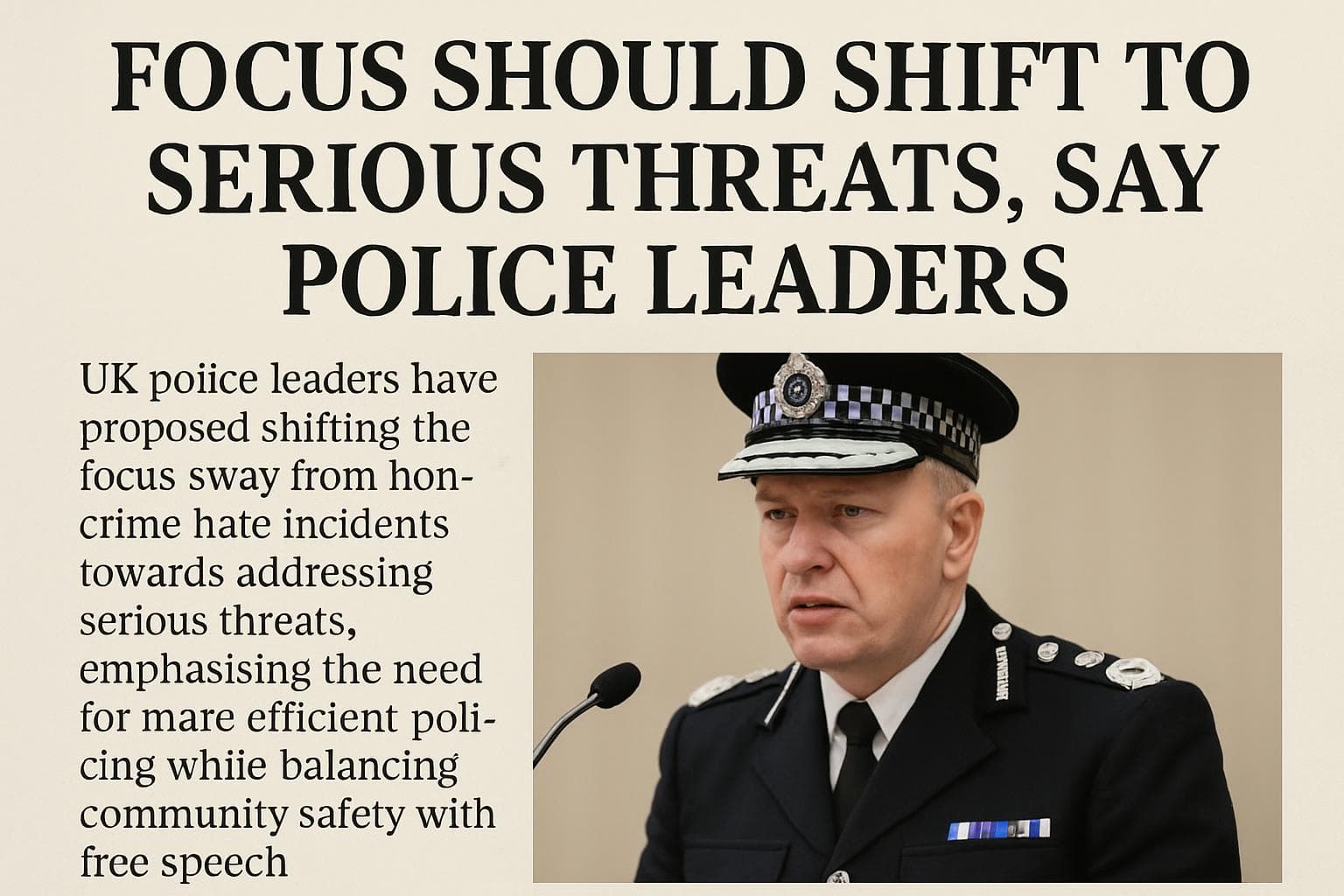
UK Police Leaders Propose Scrapping Non-Crime Hate Incidents to Focus on Serious Threats
In This Article
HIGHLIGHTS
- Police leaders are recommending the abolition of non-crime hate incidents (NCHIs) in favor of a more focused approach on serious antisocial behavior.
- The College of Policing and National Police Chiefs' Council will present their review to the home secretary next month.
- Critics argue that NCHIs divert police resources and infringe on freedom of speech, with over 133,000 recorded since 2014.
- The Metropolitan Police have already ceased investigating NCHIs to prioritize criminal investigations.
- The new proposals aim to balance community safety with protecting free speech, amid concerns over police involvement in social media disputes.
In a significant shift in policing strategy, UK police leaders are set to recommend the abolition of non-crime hate incidents (NCHIs), advocating for a more focused approach on serious antisocial behavior. This recommendation comes as part of a review by the College of Policing and the National Police Chiefs' Council, which will be presented to the home secretary next month.
Background and Rationale
NCHIs, which are perceived acts of hostility or prejudice that do not meet the threshold of a criminal offense, have been a point of contention. Initially introduced following the Stephen Lawrence inquiry, they were intended to monitor potential precursors to more serious crimes. However, critics argue that these incidents, which remain on police records and can surface during background checks, divert valuable police resources and infringe on freedom of speech. Lord Herbert, chair of the College of Policing, emphasized the need for a "sensible" approach, noting that the rise of social media has led to police involvement in "mere disputes" online.
Current Developments
The Metropolitan Police's decision in October to stop investigating NCHIs highlights a growing consensus that police efforts should focus on criminal investigations. This move followed publicized cases, such as that of Father Ted creator Graham Linehan, whose social media posts led to an NCHI investigation. The proposed changes would see NCHIs treated as intelligence reports rather than logged on crime databases, with officers using a "commonsense" checklist to assess incidents.
Balancing Safety and Free Speech
The review aims to strike a balance between community safety and protecting free speech. Rachel Swann, vice-chair of the National Police Chiefs' Council, stated that while it is crucial to monitor risks to vulnerable people and community tensions, policing should not involve refereeing online cultural debates. The home secretary will ultimately decide on the adoption of these recommendations.
WHAT THIS MIGHT MEAN
If the recommendations are adopted, the UK could see a significant shift in how police resources are allocated, potentially leading to more efficient handling of serious threats and criminal behavior. However, this move may also spark debates on the boundaries of free speech and the role of police in monitoring social media. Experts suggest that while the new approach could enhance public trust in policing, it will be crucial to ensure that vulnerable communities remain protected from hate and prejudice. The home secretary's decision will likely set a precedent for future policing strategies in the digital age.
Related Articles

Police Federation Chief Arrested Amid Fraud Investigation

Canada and Australia Forge Strategic Partnership Amid Global Uncertainty
UK Government to Reform Asylum Seeker Support and Employment Policies

Middle East Conflict Drives UK Energy Prices to New Highs

UK Faces Dilemmas Amid Iran Conflict and China Spying Allegations

UK Reinforces Military Presence in Cyprus Amid Middle East Tensions
UK Police Leaders Propose Scrapping Non-Crime Hate Incidents to Focus on Serious Threats
In This Article
 Sofia Romano| Published
 HIGHLIGHTS
- Police leaders are recommending the abolition of non-crime hate incidents (NCHIs) in favor of a more focused approach on serious antisocial behavior.
- The College of Policing and National Police Chiefs' Council will present their review to the home secretary next month.
- Critics argue that NCHIs divert police resources and infringe on freedom of speech, with over 133,000 recorded since 2014.
- The Metropolitan Police have already ceased investigating NCHIs to prioritize criminal investigations.
- The new proposals aim to balance community safety with protecting free speech, amid concerns over police involvement in social media disputes.
In a significant shift in policing strategy, UK police leaders are set to recommend the abolition of non-crime hate incidents (NCHIs), advocating for a more focused approach on serious antisocial behavior. This recommendation comes as part of a review by the College of Policing and the National Police Chiefs' Council, which will be presented to the home secretary next month.
Background and Rationale
NCHIs, which are perceived acts of hostility or prejudice that do not meet the threshold of a criminal offense, have been a point of contention. Initially introduced following the Stephen Lawrence inquiry, they were intended to monitor potential precursors to more serious crimes. However, critics argue that these incidents, which remain on police records and can surface during background checks, divert valuable police resources and infringe on freedom of speech. Lord Herbert, chair of the College of Policing, emphasized the need for a "sensible" approach, noting that the rise of social media has led to police involvement in "mere disputes" online.
Current Developments
The Metropolitan Police's decision in October to stop investigating NCHIs highlights a growing consensus that police efforts should focus on criminal investigations. This move followed publicized cases, such as that of Father Ted creator Graham Linehan, whose social media posts led to an NCHI investigation. The proposed changes would see NCHIs treated as intelligence reports rather than logged on crime databases, with officers using a "commonsense" checklist to assess incidents.
Balancing Safety and Free Speech
The review aims to strike a balance between community safety and protecting free speech. Rachel Swann, vice-chair of the National Police Chiefs' Council, stated that while it is crucial to monitor risks to vulnerable people and community tensions, policing should not involve refereeing online cultural debates. The home secretary will ultimately decide on the adoption of these recommendations.
WHAT THIS MIGHT MEAN
If the recommendations are adopted, the UK could see a significant shift in how police resources are allocated, potentially leading to more efficient handling of serious threats and criminal behavior. However, this move may also spark debates on the boundaries of free speech and the role of police in monitoring social media. Experts suggest that while the new approach could enhance public trust in policing, it will be crucial to ensure that vulnerable communities remain protected from hate and prejudice. The home secretary's decision will likely set a precedent for future policing strategies in the digital age.
Related Articles
Police Federation Chief Arrested Amid Fraud Investigation
Canada and Australia Forge Strategic Partnership Amid Global Uncertainty
UK Government to Reform Asylum Seeker Support and Employment Policies
Middle East Conflict Drives UK Energy Prices to New Highs
UK Faces Dilemmas Amid Iran Conflict and China Spying Allegations
UK Reinforces Military Presence in Cyprus Amid Middle East Tensions