
UK's Social Mobility Strategy Criticized for Lack of Coherence
In This Article
HIGHLIGHTS
- The UK lacks a coherent strategy for social mobility, according to Social Mobility Commissioner Alun Francis.
- A recent report highlights extreme regional disparities, with former industrial areas facing significant disadvantages.
- Almost one million young people are currently not in education, employment, or training, marking a crisis in youth unemployment.
- The government has been criticized for its "stop-start" policies and lack of an overarching narrative to address social mobility.
- Alan Milburn is set to lead a review aimed at building a system to improve opportunities for young people.
The UK government's approach to social mobility has come under scrutiny, with Social Mobility Commissioner Alun Francis highlighting a lack of a coherent strategy to address entrenched inequalities. In a recent interview, Francis emphasized the absence of an overarching narrative to unify various policies aimed at improving social mobility, a concern echoed in the Social Mobility Commission's (SMC) latest report.
Regional Disparities and Youth Unemployment
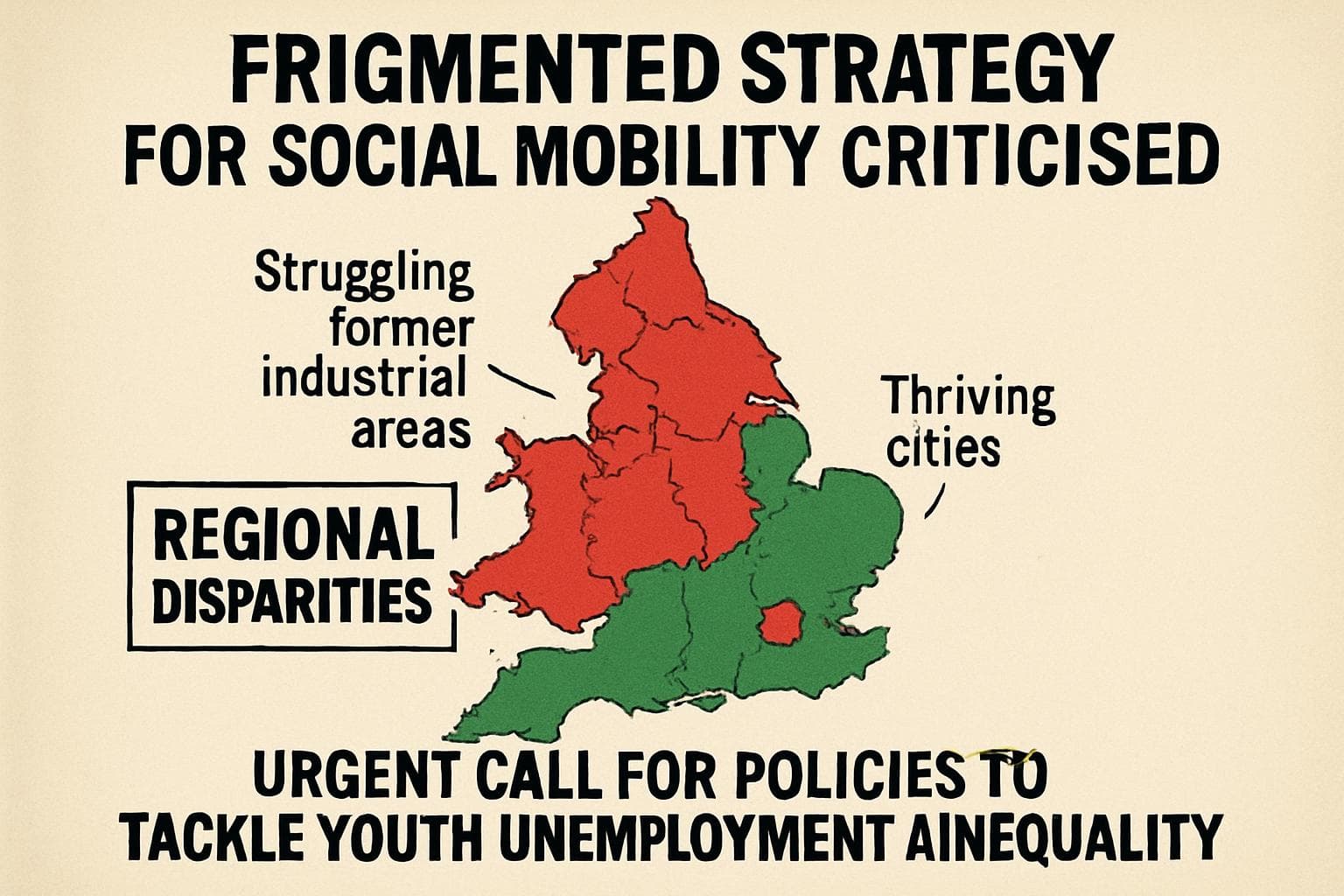
The SMC report, released last week, paints a stark picture of regional disparities across the UK. Former industrial and mining areas, particularly in the North East, Yorkshire, and the West Midlands, are identified as regions facing enduring disadvantages. Meanwhile, cities like Manchester, Edinburgh, and Bristol are beginning to thrive, but opportunities remain overconcentrated.
The report also highlights a concerning rise in youth unemployment, with nearly one million young people not engaged in education, employment, or training. This marks the sharpest increase in three years, underscoring the urgent need for a comprehensive strategy to address this crisis.
Criticism of Government Policies
Francis criticized the government's "stop-start" approach to policies on growth and educational improvement, noting that without a clear strategy, efforts to tackle social mobility will falter. While acknowledging positive steps in devolution and housing policies, he stressed the need for a unified vision to guide future initiatives.
The SMC report further warns that without a universal understanding of social mobility, it risks being overshadowed by diversity, equality, and inclusion (DEI) agendas. Francis emphasized that social mobility should be viewed as an economic and social policy aimed at benefiting everyone.
Alan Milburn's Upcoming Review
In response to these challenges, former Health Secretary Alan Milburn is set to lead a review focused on creating a system that ensures young people have opportunities to succeed. Milburn described the current situation as a "national outrage" and a "social injustice," calling for urgent action to address the economic catastrophe facing disadvantaged youth.
WHAT THIS MIGHT MEAN
The upcoming review led by Alan Milburn could potentially reshape the UK's approach to social mobility, offering a more structured and comprehensive strategy. If successful, this could lead to targeted interventions in regions most affected by economic inequality, potentially reducing youth unemployment and improving educational opportunities.
Politically, the government's handling of social mobility may become a focal point in upcoming elections, with parties likely to emphasize their commitment to addressing regional disparities and economic inequality. The outcome of Milburn's review could influence policy directions and public perception of the government's effectiveness in tackling these critical issues.
Related Articles

Trump's New Tariff Strategy Sparks Global Trade Uncertainty

US Supreme Court Ruling on Tariffs Sparks Uncertainty for UK and Global Trade

Police Federation Chief Arrested Amid Fraud Investigation

Canada and Australia Forge Strategic Partnership Amid Global Uncertainty

UK Government to Reform Asylum Seeker Support and Employment Policies

Middle East Conflict Drives UK Energy Prices to New Highs
UK's Social Mobility Strategy Criticized for Lack of Coherence
In This Article
 Daniel Rivera| Published
 HIGHLIGHTS
- The UK lacks a coherent strategy for social mobility, according to Social Mobility Commissioner Alun Francis.
- A recent report highlights extreme regional disparities, with former industrial areas facing significant disadvantages.
- Almost one million young people are currently not in education, employment, or training, marking a crisis in youth unemployment.
- The government has been criticized for its "stop-start" policies and lack of an overarching narrative to address social mobility.
- Alan Milburn is set to lead a review aimed at building a system to improve opportunities for young people.
The UK government's approach to social mobility has come under scrutiny, with Social Mobility Commissioner Alun Francis highlighting a lack of a coherent strategy to address entrenched inequalities. In a recent interview, Francis emphasized the absence of an overarching narrative to unify various policies aimed at improving social mobility, a concern echoed in the Social Mobility Commission's (SMC) latest report.
Regional Disparities and Youth Unemployment
The SMC report, released last week, paints a stark picture of regional disparities across the UK. Former industrial and mining areas, particularly in the North East, Yorkshire, and the West Midlands, are identified as regions facing enduring disadvantages. Meanwhile, cities like Manchester, Edinburgh, and Bristol are beginning to thrive, but opportunities remain overconcentrated.
The report also highlights a concerning rise in youth unemployment, with nearly one million young people not engaged in education, employment, or training. This marks the sharpest increase in three years, underscoring the urgent need for a comprehensive strategy to address this crisis.
Criticism of Government Policies
Francis criticized the government's "stop-start" approach to policies on growth and educational improvement, noting that without a clear strategy, efforts to tackle social mobility will falter. While acknowledging positive steps in devolution and housing policies, he stressed the need for a unified vision to guide future initiatives.
The SMC report further warns that without a universal understanding of social mobility, it risks being overshadowed by diversity, equality, and inclusion (DEI) agendas. Francis emphasized that social mobility should be viewed as an economic and social policy aimed at benefiting everyone.
Alan Milburn's Upcoming Review
In response to these challenges, former Health Secretary Alan Milburn is set to lead a review focused on creating a system that ensures young people have opportunities to succeed. Milburn described the current situation as a "national outrage" and a "social injustice," calling for urgent action to address the economic catastrophe facing disadvantaged youth.
WHAT THIS MIGHT MEAN
The upcoming review led by Alan Milburn could potentially reshape the UK's approach to social mobility, offering a more structured and comprehensive strategy. If successful, this could lead to targeted interventions in regions most affected by economic inequality, potentially reducing youth unemployment and improving educational opportunities.
Politically, the government's handling of social mobility may become a focal point in upcoming elections, with parties likely to emphasize their commitment to addressing regional disparities and economic inequality. The outcome of Milburn's review could influence policy directions and public perception of the government's effectiveness in tackling these critical issues.
Related Articles
Trump's New Tariff Strategy Sparks Global Trade Uncertainty
US Supreme Court Ruling on Tariffs Sparks Uncertainty for UK and Global Trade
Police Federation Chief Arrested Amid Fraud Investigation
Canada and Australia Forge Strategic Partnership Amid Global Uncertainty
UK Government to Reform Asylum Seeker Support and Employment Policies
Middle East Conflict Drives UK Energy Prices to New Highs