
Federal Court Blocks Texas Voting Maps Over Racial Gerrymandering Concerns
In This Article
HIGHLIGHTS
- A US federal court blocked Texas from using new voting maps, citing racial gerrymandering concerns.
- The court ordered Texas to revert to the 2021 maps for the upcoming midterm elections.
- Texas Governor Greg Abbott plans to appeal the decision to the US Supreme Court.
- The ruling is part of a broader national debate on redistricting and its political implications.
- The decision follows similar legal challenges in other states, highlighting the contentious nature of redistricting.
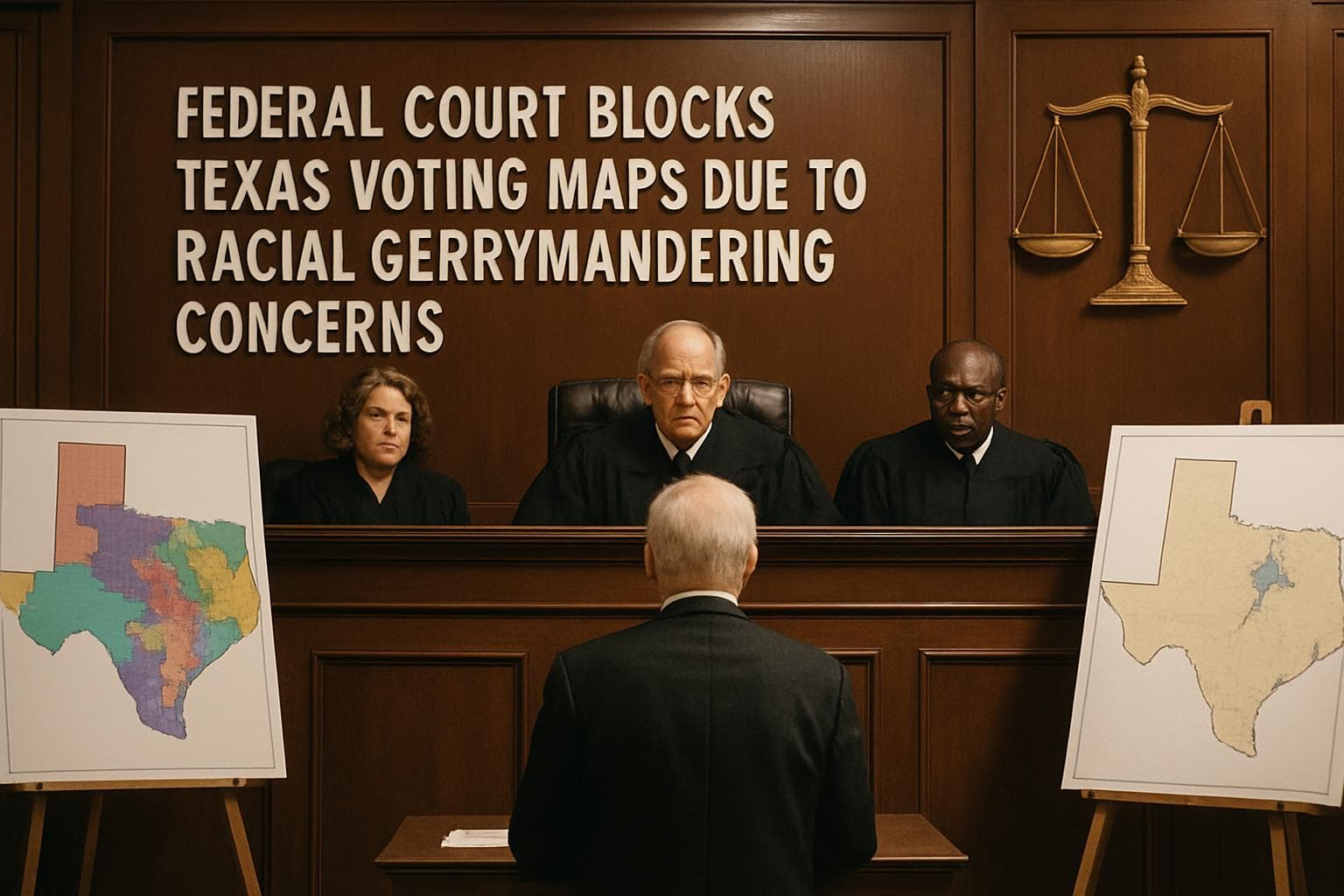
A US federal court has intervened in Texas's redistricting efforts, blocking the state from implementing newly drawn voting maps that were set to be used in the 2026 midterm elections. The court's decision, issued on Tuesday, found substantial evidence that the maps were racially gerrymandered, prompting an order for Texas to revert to its 2021 congressional lines.
Court's Decision and Political Reactions
The ruling, delivered by a panel of three federal judges, underscores the ongoing national debate over redistricting practices. Judge Jeffrey Brown, a Trump appointee, noted that while politics played a role in the creation of the 2025 maps, the evidence suggested racial motivations were at play. "Substantial evidence shows that Texas racially gerrymandered the 2025 Map," Brown stated.
Texas Governor Greg Abbott has expressed his intention to appeal the ruling to the US Supreme Court, labeling the decision as "clearly erroneous." Abbott defended the maps, asserting they were drawn to reflect Texans' conservative preferences, not to discriminate.
Broader Implications and National Context
The Texas case is part of a larger trend where states are redrawing electoral boundaries to gain political advantage. Both Republican and Democratic states have engaged in this practice, with recent legal challenges emerging in states like Utah and California. The court's decision in Texas highlights the legal boundaries of redistricting, where racial gerrymandering remains a contentious issue.
Democratic leaders in Texas, including Gene Wu, have praised the court's intervention. Wu described the blocked maps as "one of the most brazen attempts to steal our democracy," emphasizing the importance of fair representation.
Legal and Political Landscape
Redistricting typically follows the release of new census data, but mid-decade adjustments have become more common, often leading to protracted legal battles. While partisan gerrymandering is not prohibited, maps that are racially motivated can be challenged in court. The Texas ruling reflects this legal nuance, as the court found the state's actions crossed the line into racial discrimination.
WHAT THIS MIGHT MEAN
The Texas case is likely to escalate to the US Supreme Court, where the outcome could set a significant precedent for future redistricting efforts nationwide. If the court upholds the lower court's decision, it may deter similar gerrymandering attempts in other states. Conversely, a reversal could embolden states to pursue aggressive redistricting strategies.
Politically, the ruling may influence the balance of power in Congress, as redistricting can significantly impact electoral outcomes. As states continue to navigate the complex legal landscape of redistricting, the Texas case serves as a critical touchpoint in the broader conversation about fair representation and electoral integrity.
Related Articles
Congress Subpoenas Attorney General Bondi in Epstein Investigation

James Talarico Secures Democratic Nomination in Texas Senate Race Amidst Republican Runoff
Senate Blocks Resolution to Limit Trump's Military Actions in Iran

US Supreme Court Ruling Sparks Trade Uncertainty in Asia and Beyond

Tech Giants Pledge to Cover AI Data Center Energy Costs Amid Rising Electricity Concerns

Cuba Faces Widespread Blackout Amid Deepening Fuel Crisis
Federal Court Blocks Texas Voting Maps Over Racial Gerrymandering Concerns
In This Article
 Alex Carter| Published
 HIGHLIGHTS
- A US federal court blocked Texas from using new voting maps, citing racial gerrymandering concerns.
- The court ordered Texas to revert to the 2021 maps for the upcoming midterm elections.
- Texas Governor Greg Abbott plans to appeal the decision to the US Supreme Court.
- The ruling is part of a broader national debate on redistricting and its political implications.
- The decision follows similar legal challenges in other states, highlighting the contentious nature of redistricting.
A US federal court has intervened in Texas's redistricting efforts, blocking the state from implementing newly drawn voting maps that were set to be used in the 2026 midterm elections. The court's decision, issued on Tuesday, found substantial evidence that the maps were racially gerrymandered, prompting an order for Texas to revert to its 2021 congressional lines.
Court's Decision and Political Reactions
The ruling, delivered by a panel of three federal judges, underscores the ongoing national debate over redistricting practices. Judge Jeffrey Brown, a Trump appointee, noted that while politics played a role in the creation of the 2025 maps, the evidence suggested racial motivations were at play. "Substantial evidence shows that Texas racially gerrymandered the 2025 Map," Brown stated.
Texas Governor Greg Abbott has expressed his intention to appeal the ruling to the US Supreme Court, labeling the decision as "clearly erroneous." Abbott defended the maps, asserting they were drawn to reflect Texans' conservative preferences, not to discriminate.
Broader Implications and National Context
The Texas case is part of a larger trend where states are redrawing electoral boundaries to gain political advantage. Both Republican and Democratic states have engaged in this practice, with recent legal challenges emerging in states like Utah and California. The court's decision in Texas highlights the legal boundaries of redistricting, where racial gerrymandering remains a contentious issue.
Democratic leaders in Texas, including Gene Wu, have praised the court's intervention. Wu described the blocked maps as "one of the most brazen attempts to steal our democracy," emphasizing the importance of fair representation.
Legal and Political Landscape
Redistricting typically follows the release of new census data, but mid-decade adjustments have become more common, often leading to protracted legal battles. While partisan gerrymandering is not prohibited, maps that are racially motivated can be challenged in court. The Texas ruling reflects this legal nuance, as the court found the state's actions crossed the line into racial discrimination.
WHAT THIS MIGHT MEAN
The Texas case is likely to escalate to the US Supreme Court, where the outcome could set a significant precedent for future redistricting efforts nationwide. If the court upholds the lower court's decision, it may deter similar gerrymandering attempts in other states. Conversely, a reversal could embolden states to pursue aggressive redistricting strategies.
Politically, the ruling may influence the balance of power in Congress, as redistricting can significantly impact electoral outcomes. As states continue to navigate the complex legal landscape of redistricting, the Texas case serves as a critical touchpoint in the broader conversation about fair representation and electoral integrity.
Related Articles
Congress Subpoenas Attorney General Bondi in Epstein Investigation
James Talarico Secures Democratic Nomination in Texas Senate Race Amidst Republican Runoff
Senate Blocks Resolution to Limit Trump's Military Actions in Iran
US Supreme Court Ruling Sparks Trade Uncertainty in Asia and Beyond
Tech Giants Pledge to Cover AI Data Center Energy Costs Amid Rising Electricity Concerns
Cuba Faces Widespread Blackout Amid Deepening Fuel Crisis