
Farage's Ambitious £17bn Plan to Halve UK Crime Sparks Debate
In This Article
HIGHLIGHTS
- Nigel Farage proposes a £17.4bn plan to halve UK crime, including building five new prisons and deporting foreign prisoners.
- The Reform UK leader suggests funding these measures by cutting public spending on projects like HS2 and net-zero policies.
- Farage claims crime has significantly increased since the 1990s, though official statistics show a more nuanced picture.
- Critics argue that Farage's proposals are unfunded and lack a clear implementation strategy.
- Farage's plan includes recruiting 30,000 new police officers to enhance public safety.
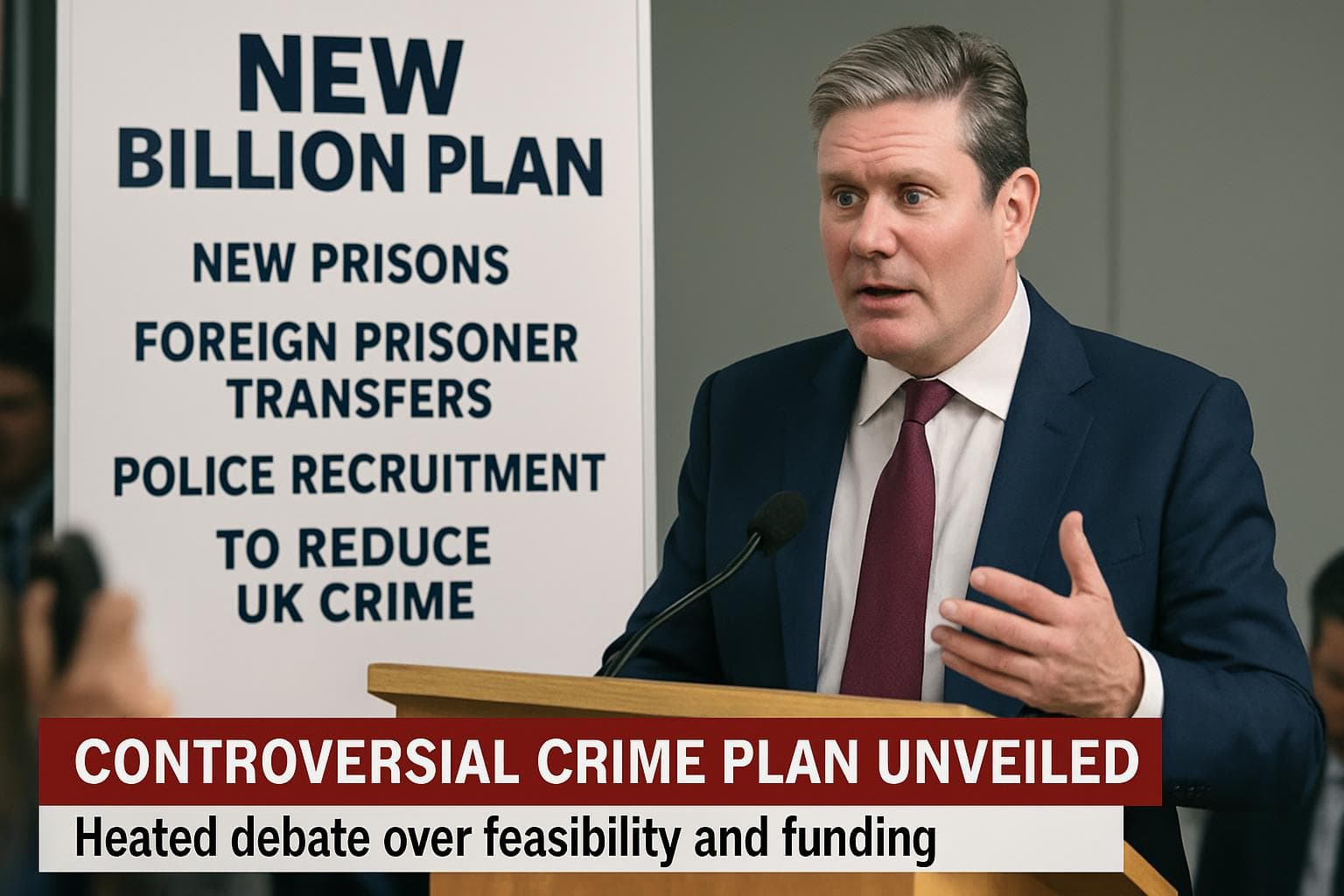
Nigel Farage, leader of Reform UK, has unveiled a bold £17.4 billion plan aimed at halving crime in the UK within five years. Speaking at a press conference in London, Farage outlined a series of measures, including the construction of five new 'Nightingale' prisons and the deportation of over 10,000 foreign prisoners. The plan, he claims, will be funded by cutting public spending on projects such as the HS2 rail line and net-zero initiatives.
Proposed Measures and Funding
Farage's strategy includes creating 12,400 prison spaces through the construction of low-security prisons on Ministry of Defence land, inspired by the temporary hospitals set up during the COVID-19 pandemic. Additionally, he proposes transferring foreign prisoners back to their home countries, potentially accepting British offenders in return. The plan also involves sending serious offenders to serve sentences abroad, with countries like Kosovo and Estonia mentioned as possible locations.
To bolster public safety, Farage aims to recruit 30,000 new police officers, emphasizing the need for a "higher and physically tougher" standard. Reform UK estimates the annual cost of these initiatives at £3.48 billion, with police recruitment accounting for £2.1 billion.
Controversy and Criticism
Farage's proposals have sparked criticism from political opponents. Labour has dismissed the plans as "unfunded," while the Conservatives accuse him of offering "tough talk without a clear delivery plan." Despite these criticisms, Farage insists that the cost of crime, which he estimates at £170 billion annually, justifies the proposed spending.
Crime Statistics and Public Perception
Farage argues that crime has surged since the 1990s, leading to a societal collapse. However, official statistics from the Office for National Statistics (ONS) suggest a more complex picture, with long-term declines in certain crimes but recent increases in others, such as fraud and theft. Public concern over crime remains significant, with a YouGov poll indicating that 22% of voters see it as a major issue.
WHAT THIS MIGHT MEAN
If implemented, Farage's proposals could significantly alter the UK's approach to crime and punishment. However, the feasibility of funding these initiatives through cuts to projects like HS2 remains contentious. Critics argue that without a detailed implementation plan, the proposals risk being seen as mere rhetoric.
Politically, Farage's tough stance on crime may resonate with voters concerned about public safety, potentially boosting Reform UK's appeal. However, the party's ability to deliver on these promises will be crucial in determining its long-term impact on the UK's political landscape. As the debate continues, the effectiveness of Farage's proposals will likely hinge on their practical execution and public reception.
Related Articles
Reform UK to Reinstate Two-Child Benefit Cap Amidst Political Controversy
Reform UK Aims to Reshape Welsh Politics with New Manifesto

Global Counsel Faces Collapse Amidst Epstein Scandal Fallout
Starmer Condemns Reform UK's Plan to Repeal Equality Act as Un-British
UK Reinforces Military Presence in Cyprus Amid Middle East Tensions
Labour MP's Husband Arrested in UK-China Espionage Probe
Farage's Ambitious £17bn Plan to Halve UK Crime Sparks Debate
In This Article
 Ethan Brooks| Published
 HIGHLIGHTS
- Nigel Farage proposes a £17.4bn plan to halve UK crime, including building five new prisons and deporting foreign prisoners.
- The Reform UK leader suggests funding these measures by cutting public spending on projects like HS2 and net-zero policies.
- Farage claims crime has significantly increased since the 1990s, though official statistics show a more nuanced picture.
- Critics argue that Farage's proposals are unfunded and lack a clear implementation strategy.
- Farage's plan includes recruiting 30,000 new police officers to enhance public safety.
Nigel Farage, leader of Reform UK, has unveiled a bold £17.4 billion plan aimed at halving crime in the UK within five years. Speaking at a press conference in London, Farage outlined a series of measures, including the construction of five new 'Nightingale' prisons and the deportation of over 10,000 foreign prisoners. The plan, he claims, will be funded by cutting public spending on projects such as the HS2 rail line and net-zero initiatives.
Proposed Measures and Funding
Farage's strategy includes creating 12,400 prison spaces through the construction of low-security prisons on Ministry of Defence land, inspired by the temporary hospitals set up during the COVID-19 pandemic. Additionally, he proposes transferring foreign prisoners back to their home countries, potentially accepting British offenders in return. The plan also involves sending serious offenders to serve sentences abroad, with countries like Kosovo and Estonia mentioned as possible locations.
To bolster public safety, Farage aims to recruit 30,000 new police officers, emphasizing the need for a "higher and physically tougher" standard. Reform UK estimates the annual cost of these initiatives at £3.48 billion, with police recruitment accounting for £2.1 billion.
Controversy and Criticism
Farage's proposals have sparked criticism from political opponents. Labour has dismissed the plans as "unfunded," while the Conservatives accuse him of offering "tough talk without a clear delivery plan." Despite these criticisms, Farage insists that the cost of crime, which he estimates at £170 billion annually, justifies the proposed spending.
Crime Statistics and Public Perception
Farage argues that crime has surged since the 1990s, leading to a societal collapse. However, official statistics from the Office for National Statistics (ONS) suggest a more complex picture, with long-term declines in certain crimes but recent increases in others, such as fraud and theft. Public concern over crime remains significant, with a YouGov poll indicating that 22% of voters see it as a major issue.
WHAT THIS MIGHT MEAN
If implemented, Farage's proposals could significantly alter the UK's approach to crime and punishment. However, the feasibility of funding these initiatives through cuts to projects like HS2 remains contentious. Critics argue that without a detailed implementation plan, the proposals risk being seen as mere rhetoric.
Politically, Farage's tough stance on crime may resonate with voters concerned about public safety, potentially boosting Reform UK's appeal. However, the party's ability to deliver on these promises will be crucial in determining its long-term impact on the UK's political landscape. As the debate continues, the effectiveness of Farage's proposals will likely hinge on their practical execution and public reception.
Related Articles
Reform UK to Reinstate Two-Child Benefit Cap Amidst Political Controversy
Reform UK Aims to Reshape Welsh Politics with New Manifesto
Global Counsel Faces Collapse Amidst Epstein Scandal Fallout
Starmer Condemns Reform UK's Plan to Repeal Equality Act as Un-British
UK Reinforces Military Presence in Cyprus Amid Middle East Tensions
Labour MP's Husband Arrested in UK-China Espionage Probe