
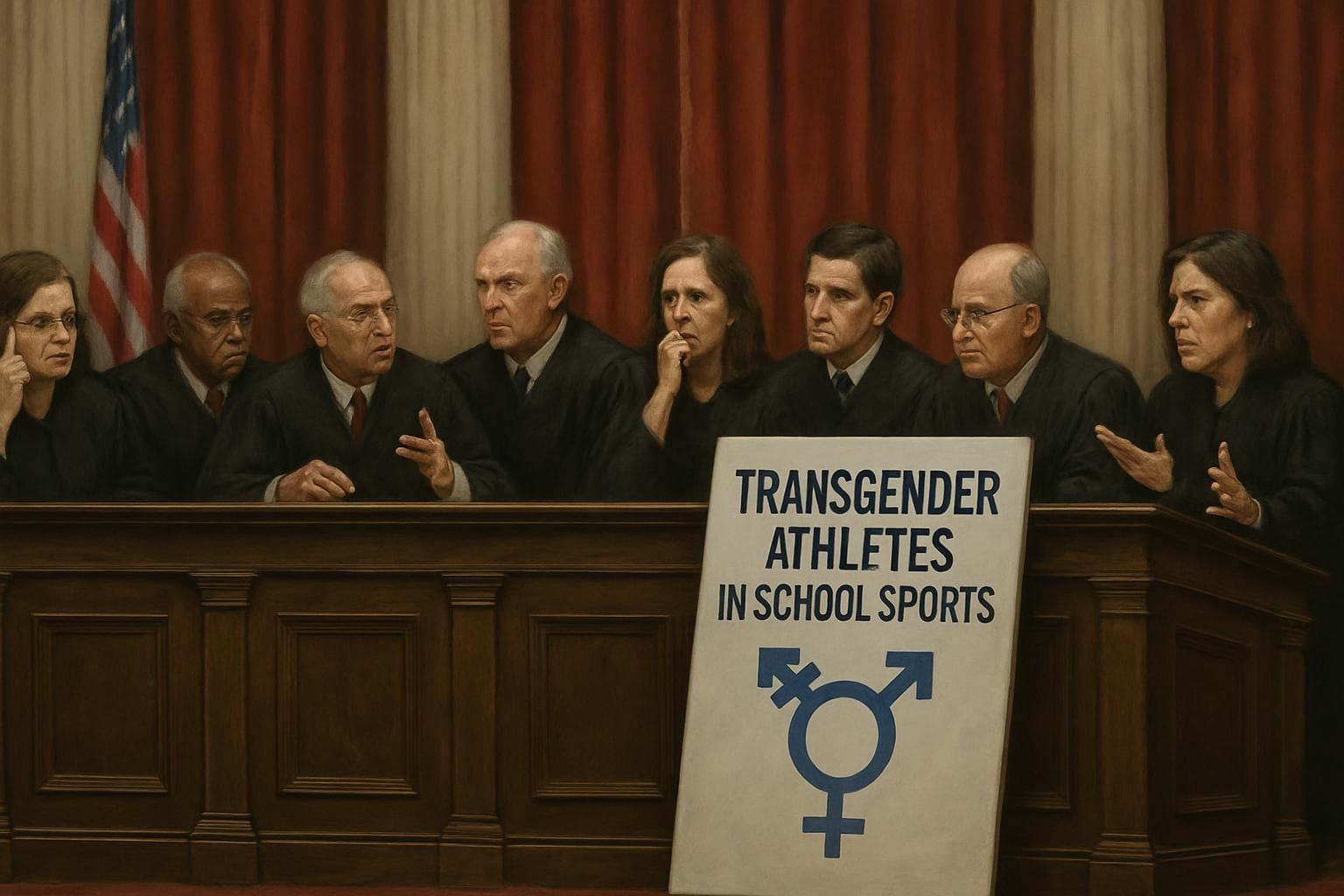
US Supreme Court Likely to Uphold State Bans on Transgender Athletes in School Sports
In This Article
HIGHLIGHTS
- The US Supreme Court appears inclined to uphold state bans on transgender women and girls competing in female sports, with a conservative majority leaning towards supporting the restrictions.
- Cases from Idaho and West Virginia challenge these bans, arguing they violate constitutional equal rights and federal civil rights laws, including Title IX.
- Justice Brett Kavanaugh and other conservative justices expressed concerns that allowing transgender athletes could undermine the success of women's sports.
- The legal battle involves a small number of athletes, with arguments focusing on whether transgender athletes have an unfair biological advantage.
- The outcome could have significant implications for LGBTQ+ rights, affecting policies beyond sports, such as bathroom access and pronoun use.
The US Supreme Court is poised to uphold state laws that ban transgender women and girls from participating in female sports, following oral arguments on Tuesday. The cases, originating from Idaho and West Virginia, challenge the legality of these bans, which require sports teams to be designated based on sex recorded at birth. The court's conservative majority, led by Justice Brett Kavanaugh, expressed skepticism about the students' cases, suggesting that allowing transgender athletes could threaten the success of women's sports in the US.
Legal Context and Arguments
Idaho was the first state to implement such a ban in 2020, and now over two dozen states have similar legislation. The legal challenges argue that these bans violate constitutional equal rights protections and Title IX, a federal law prohibiting sex discrimination in schools. Alan Hurst, Idaho's solicitor general, defended the state's position, stating, "Idaho's law classifies on the basis of sex, because sex is what matters in sports."
Personal Stories and Implications
The cases involve Lindsay Hecox, a college student from Idaho, and Becky Pepper-Jackson, a high school student from West Virginia. Hecox, who no longer wishes to compete, argued that her use of testosterone suppressants mitigated any competitive advantage. Pepper-Jackson, represented by the ACLU, began gender-affirming treatment at a young age, avoiding male puberty and its associated advantages.
Broader Impact on LGBTQ+ Rights
The Supreme Court's decision could have wide-ranging implications for LGBTQ+ rights across the US. While the focus is on sports, the outcome may influence other policies affecting transgender individuals, such as bathroom access and the use of chosen pronouns. The legal battle highlights the ongoing debate over fairness and inclusion in athletics, with both sides acknowledging the small number of athletes directly affected.
WHAT THIS MIGHT MEAN
If the Supreme Court upholds the state bans, it could set a precedent that influences future cases involving transgender rights, potentially affecting policies beyond sports. Legal experts suggest that such a ruling might embolden states to enact further restrictions on transgender individuals, impacting their access to public facilities and participation in various aspects of public life. Conversely, a decision against the bans could reinforce protections under Title IX, affirming the rights of transgender students to participate in sports consistent with their gender identity. The court's ruling will likely shape the national conversation on gender identity and equality for years to come.
Related Articles

Tragedy Strikes as Avalanche Claims Eight Lives in California's Sierra Nevada
US Supreme Court Ruling Sparks Trade Uncertainty in Asia and Beyond
Trump Criticizes Supreme Court After Tariff Ruling, Imposes New Global Tariff

US Supreme Court Ruling on Tariffs Sparks Uncertainty for UK and Global Trade
US Supreme Court Ruling on Trump's Tariffs Sparks Trade Policy Uncertainty
Trump's Tariff Strategy Faces Supreme Court Setback, New Measures Announced
US Supreme Court Likely to Uphold State Bans on Transgender Athletes in School Sports
In This Article
 Marcus Blake| Published
 HIGHLIGHTS
- The US Supreme Court appears inclined to uphold state bans on transgender women and girls competing in female sports, with a conservative majority leaning towards supporting the restrictions.
- Cases from Idaho and West Virginia challenge these bans, arguing they violate constitutional equal rights and federal civil rights laws, including Title IX.
- Justice Brett Kavanaugh and other conservative justices expressed concerns that allowing transgender athletes could undermine the success of women's sports.
- The legal battle involves a small number of athletes, with arguments focusing on whether transgender athletes have an unfair biological advantage.
- The outcome could have significant implications for LGBTQ+ rights, affecting policies beyond sports, such as bathroom access and pronoun use.
The US Supreme Court is poised to uphold state laws that ban transgender women and girls from participating in female sports, following oral arguments on Tuesday. The cases, originating from Idaho and West Virginia, challenge the legality of these bans, which require sports teams to be designated based on sex recorded at birth. The court's conservative majority, led by Justice Brett Kavanaugh, expressed skepticism about the students' cases, suggesting that allowing transgender athletes could threaten the success of women's sports in the US.
Legal Context and Arguments
Idaho was the first state to implement such a ban in 2020, and now over two dozen states have similar legislation. The legal challenges argue that these bans violate constitutional equal rights protections and Title IX, a federal law prohibiting sex discrimination in schools. Alan Hurst, Idaho's solicitor general, defended the state's position, stating, "Idaho's law classifies on the basis of sex, because sex is what matters in sports."
Personal Stories and Implications
The cases involve Lindsay Hecox, a college student from Idaho, and Becky Pepper-Jackson, a high school student from West Virginia. Hecox, who no longer wishes to compete, argued that her use of testosterone suppressants mitigated any competitive advantage. Pepper-Jackson, represented by the ACLU, began gender-affirming treatment at a young age, avoiding male puberty and its associated advantages.
Broader Impact on LGBTQ+ Rights
The Supreme Court's decision could have wide-ranging implications for LGBTQ+ rights across the US. While the focus is on sports, the outcome may influence other policies affecting transgender individuals, such as bathroom access and the use of chosen pronouns. The legal battle highlights the ongoing debate over fairness and inclusion in athletics, with both sides acknowledging the small number of athletes directly affected.
WHAT THIS MIGHT MEAN
If the Supreme Court upholds the state bans, it could set a precedent that influences future cases involving transgender rights, potentially affecting policies beyond sports. Legal experts suggest that such a ruling might embolden states to enact further restrictions on transgender individuals, impacting their access to public facilities and participation in various aspects of public life. Conversely, a decision against the bans could reinforce protections under Title IX, affirming the rights of transgender students to participate in sports consistent with their gender identity. The court's ruling will likely shape the national conversation on gender identity and equality for years to come.
Related Articles
Tragedy Strikes as Avalanche Claims Eight Lives in California's Sierra Nevada
US Supreme Court Ruling Sparks Trade Uncertainty in Asia and Beyond
Trump Criticizes Supreme Court After Tariff Ruling, Imposes New Global Tariff
US Supreme Court Ruling on Tariffs Sparks Uncertainty for UK and Global Trade
US Supreme Court Ruling on Trump's Tariffs Sparks Trade Policy Uncertainty
Trump's Tariff Strategy Faces Supreme Court Setback, New Measures Announced