
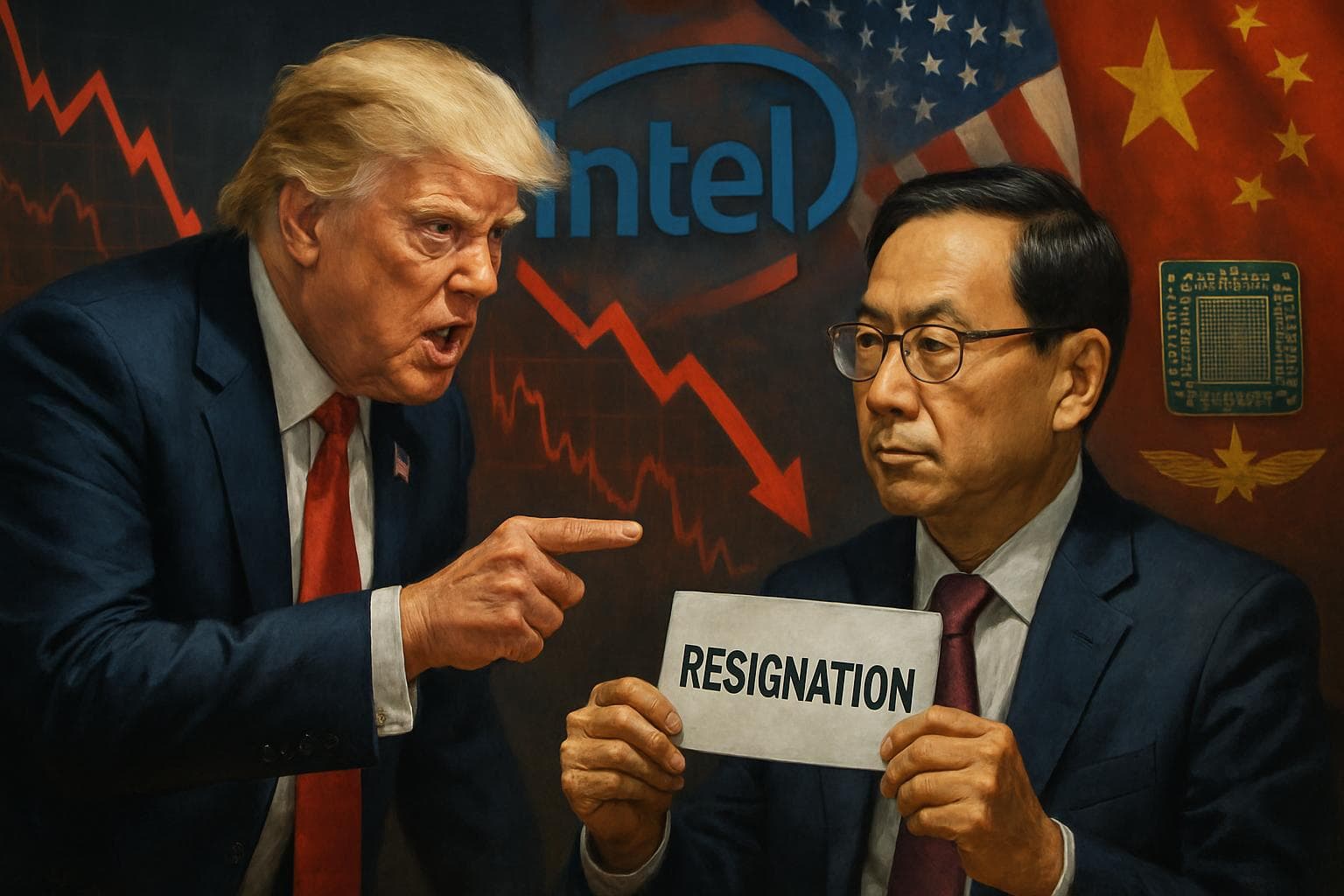
Trump Demands Intel CEO's Resignation Over Alleged China Ties
In This Article
HIGHLIGHTS
- President Donald Trump has called for Intel CEO Lip-Bu Tan's resignation, citing alleged ties to Chinese military-linked companies.
- Trump's demand follows his threat of a 100% tariff on imported semiconductors, excluding firms investing in US manufacturing.
- Intel's stock fell over 3% after Trump's comments, amid concerns about Tan's past leadership at Cadence Design Systems.
- Republican Senator Tom Cotton has raised questions about Tan's investments and their implications for US national security.
- Intel has defended Tan, emphasizing its commitment to US national and economic security interests.
President Donald Trump has intensified his scrutiny of the semiconductor industry by calling for the immediate resignation of Intel CEO Lip-Bu Tan, accusing him of having problematic ties to China. This demand comes amid heightened tensions between the US and China over technology and national security concerns.
Allegations and Market Reactions
Trump's call for Tan's resignation was made public via a post on Truth Social, where he labeled the Intel CEO as "highly conflicted." The accusations center around Tan's alleged investments in companies linked to the Chinese military, a claim that has raised eyebrows in Washington. Following Trump's remarks, Intel's shares dropped more than 3%, reflecting investor anxiety over the unfolding situation.
Political and Economic Context
The demand for Tan's resignation coincides with Trump's recent threat to impose a 100% tariff on imported semiconductors, a move aimed at bolstering US-based manufacturing. Notably, companies like Taiwan Semiconductor and Apple, which have pledged significant investments in US chip production, were exempted from this tariff threat. Apple's CEO Tim Cook announced a $100 billion investment in US chip fabrication, aligning with the administration's "America First" agenda.
Senatorial Concerns and Corporate Defense
Republican Senator Tom Cotton has echoed Trump's concerns, questioning Tan's past leadership at Cadence Design Systems, a company that admitted to violating US export controls by selling products to China's National University of Defense Technology. Cotton's letter to Intel's board highlighted Tan's connections to several Chinese firms, some allegedly linked to the People's Liberation Army. Despite these allegations, Intel has staunchly defended Tan, asserting its dedication to advancing US national and economic security.
Industry Implications
Lip-Bu Tan, a seasoned figure in the technology and venture capital sectors, was appointed as Intel's CEO in March to spearhead a turnaround for the company. Under his leadership, Intel has been restructuring, including job cuts and asset sales, to streamline operations. The company has also received substantial funding from the Chips and Science Act, aimed at reducing US reliance on foreign semiconductor manufacturing.
WHAT THIS MIGHT MEAN
The unfolding situation at Intel could have significant implications for the semiconductor industry and US-China relations. If Tan resigns, it may prompt a leadership shake-up at Intel, potentially affecting its strategic direction. The imposition of tariffs could further strain US-China trade relations, impacting global supply chains. Experts suggest that the US government's focus on national security in technology could lead to stricter regulations and increased scrutiny of foreign investments in critical sectors. As the situation develops, the semiconductor industry may face heightened geopolitical pressures, influencing corporate strategies and international collaborations.
Related Articles

Greenland Politely Declines Trump's Hospital Ship Offer Amid Healthcare Debate
Senate Blocks Resolution to Limit Trump's Military Actions in Iran
Spain's Sánchez Stands Firm Against Trump's Trade Threat Over Iran Stance
US Supreme Court Ruling Sparks Trade Uncertainty in Asia and Beyond
Trump's New Tariff Strategy Sparks Global Trade Uncertainty

US-Iran Tensions Escalate Amid Renewed Nuclear Talks and Protests
Trump Demands Intel CEO's Resignation Over Alleged China Ties
In This Article
 Ethan Brooks| Published
 HIGHLIGHTS
- President Donald Trump has called for Intel CEO Lip-Bu Tan's resignation, citing alleged ties to Chinese military-linked companies.
- Trump's demand follows his threat of a 100% tariff on imported semiconductors, excluding firms investing in US manufacturing.
- Intel's stock fell over 3% after Trump's comments, amid concerns about Tan's past leadership at Cadence Design Systems.
- Republican Senator Tom Cotton has raised questions about Tan's investments and their implications for US national security.
- Intel has defended Tan, emphasizing its commitment to US national and economic security interests.
President Donald Trump has intensified his scrutiny of the semiconductor industry by calling for the immediate resignation of Intel CEO Lip-Bu Tan, accusing him of having problematic ties to China. This demand comes amid heightened tensions between the US and China over technology and national security concerns.
Allegations and Market Reactions
Trump's call for Tan's resignation was made public via a post on Truth Social, where he labeled the Intel CEO as "highly conflicted." The accusations center around Tan's alleged investments in companies linked to the Chinese military, a claim that has raised eyebrows in Washington. Following Trump's remarks, Intel's shares dropped more than 3%, reflecting investor anxiety over the unfolding situation.
Political and Economic Context
The demand for Tan's resignation coincides with Trump's recent threat to impose a 100% tariff on imported semiconductors, a move aimed at bolstering US-based manufacturing. Notably, companies like Taiwan Semiconductor and Apple, which have pledged significant investments in US chip production, were exempted from this tariff threat. Apple's CEO Tim Cook announced a $100 billion investment in US chip fabrication, aligning with the administration's "America First" agenda.
Senatorial Concerns and Corporate Defense
Republican Senator Tom Cotton has echoed Trump's concerns, questioning Tan's past leadership at Cadence Design Systems, a company that admitted to violating US export controls by selling products to China's National University of Defense Technology. Cotton's letter to Intel's board highlighted Tan's connections to several Chinese firms, some allegedly linked to the People's Liberation Army. Despite these allegations, Intel has staunchly defended Tan, asserting its dedication to advancing US national and economic security.
Industry Implications
Lip-Bu Tan, a seasoned figure in the technology and venture capital sectors, was appointed as Intel's CEO in March to spearhead a turnaround for the company. Under his leadership, Intel has been restructuring, including job cuts and asset sales, to streamline operations. The company has also received substantial funding from the Chips and Science Act, aimed at reducing US reliance on foreign semiconductor manufacturing.
WHAT THIS MIGHT MEAN
The unfolding situation at Intel could have significant implications for the semiconductor industry and US-China relations. If Tan resigns, it may prompt a leadership shake-up at Intel, potentially affecting its strategic direction. The imposition of tariffs could further strain US-China trade relations, impacting global supply chains. Experts suggest that the US government's focus on national security in technology could lead to stricter regulations and increased scrutiny of foreign investments in critical sectors. As the situation develops, the semiconductor industry may face heightened geopolitical pressures, influencing corporate strategies and international collaborations.
Related Articles
Greenland Politely Declines Trump's Hospital Ship Offer Amid Healthcare Debate
Senate Blocks Resolution to Limit Trump's Military Actions in Iran
Spain's Sánchez Stands Firm Against Trump's Trade Threat Over Iran Stance
US Supreme Court Ruling Sparks Trade Uncertainty in Asia and Beyond
Trump's New Tariff Strategy Sparks Global Trade Uncertainty
US-Iran Tensions Escalate Amid Renewed Nuclear Talks and Protests