
UK Government Faces Backlash Over Plan to Proscribe Palestine Action as Terrorist Group
In This Article
HIGHLIGHTS
- The UK government plans to proscribe Palestine Action as a terrorist organization, sparking significant debate and criticism.
- Palestine Action activists recently broke into RAF Brize Norton, protesting UK support for Israel amid the Gaza conflict.
- The Metropolitan Police imposed restrictions on a planned protest, moving it from Parliament to Trafalgar Square.
- Critics argue that proscribing the group under anti-terrorism laws is an overreach and threatens freedom of expression.
- Home Secretary Yvette Cooper is set to present a draft proscription order to Parliament, initiating a formal process.
The UK government's decision to potentially proscribe Palestine Action as a terrorist organization has ignited a fierce debate over the boundaries of protest and freedom of expression. The move comes in the wake of a high-profile protest by the group at RAF Brize Norton, where activists spray-painted military planes to denounce the UK's support for Israel during the ongoing Gaza conflict.
Protest and Legal Context
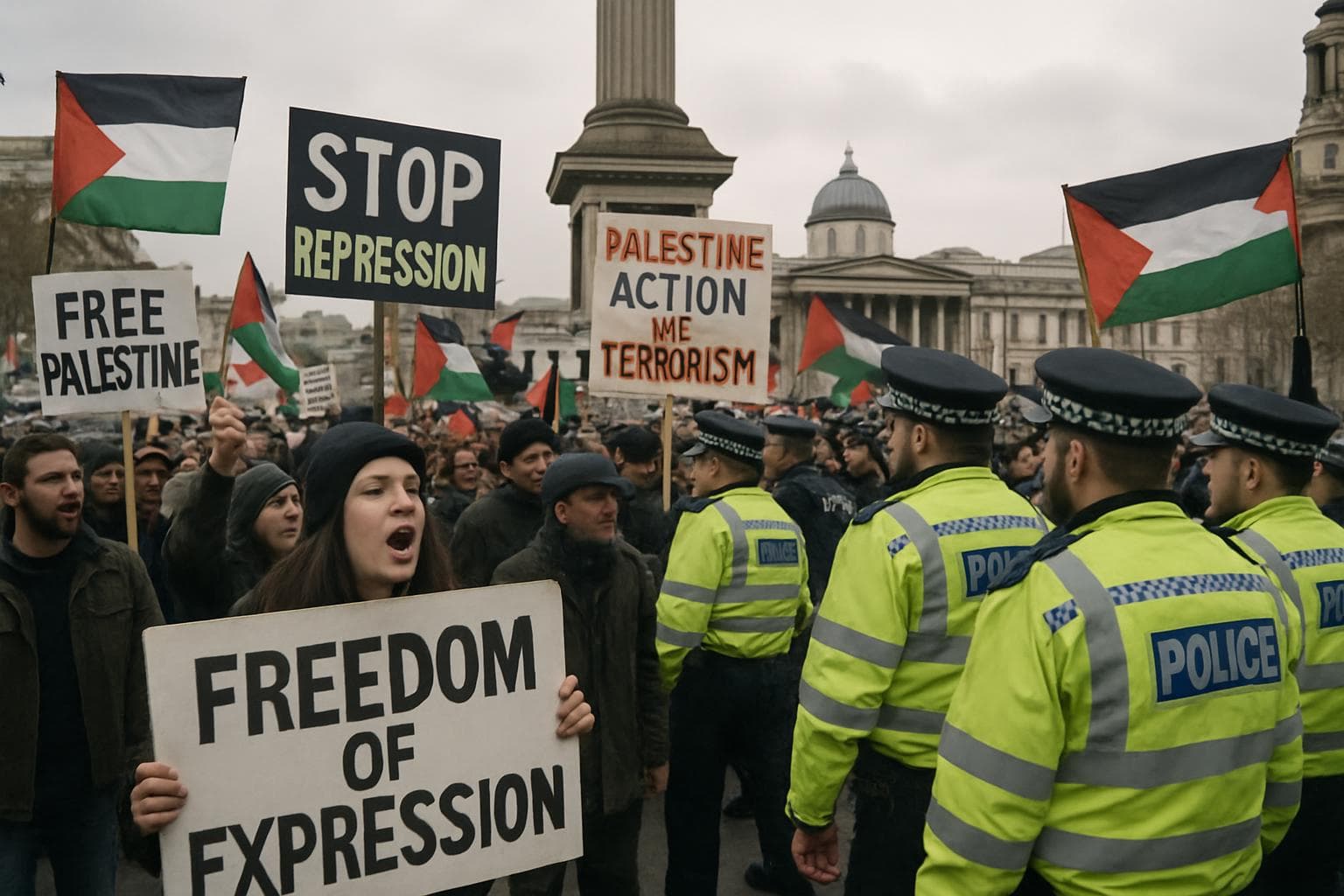
On Monday, hundreds gathered in Trafalgar Square after the Metropolitan Police enforced an exclusion zone around Parliament, citing public order concerns. The protest, initially planned for outside Parliament, was moved following police restrictions limiting the demonstration to a three-hour window. Metropolitan Police Commissioner Sir Mark Rowley expressed his frustration, stating that while the protest could not be legally stopped, conditions would be strictly enforced to prevent disorder.
Government's Stance and Criticism
Home Secretary Yvette Cooper announced plans to introduce a draft proscription order to Parliament, a move that would categorize Palestine Action alongside groups like Islamic State under the Terrorism Act 2000. This decision has faced criticism from various quarters, including human rights advocates and legal experts, who argue that such a classification is unprecedented for a protest group and poses a threat to civil liberties. Critics, including former law enforcement officials, have labeled the move as an overreach and an abuse of anti-terrorism legislation.
Public and Political Reactions
The proposal has drawn mixed reactions from political figures. While some, like former Home Secretary Suella Braverman, support the move as necessary for national security, others, including Labour peer Shami Chakrabarti, have condemned it as excessive. The debate highlights the tension between maintaining public order and upholding the right to protest, especially in the context of contentious international issues like the Israeli-Palestinian conflict.
WHAT THIS MIGHT MEAN
If the proscription order is passed, it could set a significant precedent for how protest groups are treated under UK anti-terrorism laws. This could lead to increased scrutiny and potential legal challenges from civil rights organizations concerned about the implications for freedom of expression. Politically, the decision may further polarize opinions on the UK's foreign policy stance regarding Israel and Palestine. Experts suggest that the government will need to carefully navigate these legal and political landscapes to avoid undermining democratic principles while addressing security concerns.
Related Articles

UK Faces Dilemmas Amid Iran Conflict and China Spying Allegations
Labour MP's Husband Arrested in UK-China Espionage Probe
Prince Andrew's Ties to Epstein Under Scrutiny Amid Calls for Inquiry
Iran Postpones Khamenei Funeral Amid Escalating US-Israeli Strikes
UK Police Intensify Investigation into Andrew Mountbatten-Windsor Amid Misconduct Allegations
Prince Andrew's Arrest Raises Questions About Royal Succession and Monarchy's Future
UK Government Faces Backlash Over Plan to Proscribe Palestine Action as Terrorist Group
In This Article
 Ethan Brooks| Published
 HIGHLIGHTS
- The UK government plans to proscribe Palestine Action as a terrorist organization, sparking significant debate and criticism.
- Palestine Action activists recently broke into RAF Brize Norton, protesting UK support for Israel amid the Gaza conflict.
- The Metropolitan Police imposed restrictions on a planned protest, moving it from Parliament to Trafalgar Square.
- Critics argue that proscribing the group under anti-terrorism laws is an overreach and threatens freedom of expression.
- Home Secretary Yvette Cooper is set to present a draft proscription order to Parliament, initiating a formal process.
The UK government's decision to potentially proscribe Palestine Action as a terrorist organization has ignited a fierce debate over the boundaries of protest and freedom of expression. The move comes in the wake of a high-profile protest by the group at RAF Brize Norton, where activists spray-painted military planes to denounce the UK's support for Israel during the ongoing Gaza conflict.
Protest and Legal Context
On Monday, hundreds gathered in Trafalgar Square after the Metropolitan Police enforced an exclusion zone around Parliament, citing public order concerns. The protest, initially planned for outside Parliament, was moved following police restrictions limiting the demonstration to a three-hour window. Metropolitan Police Commissioner Sir Mark Rowley expressed his frustration, stating that while the protest could not be legally stopped, conditions would be strictly enforced to prevent disorder.
Government's Stance and Criticism
Home Secretary Yvette Cooper announced plans to introduce a draft proscription order to Parliament, a move that would categorize Palestine Action alongside groups like Islamic State under the Terrorism Act 2000. This decision has faced criticism from various quarters, including human rights advocates and legal experts, who argue that such a classification is unprecedented for a protest group and poses a threat to civil liberties. Critics, including former law enforcement officials, have labeled the move as an overreach and an abuse of anti-terrorism legislation.
Public and Political Reactions
The proposal has drawn mixed reactions from political figures. While some, like former Home Secretary Suella Braverman, support the move as necessary for national security, others, including Labour peer Shami Chakrabarti, have condemned it as excessive. The debate highlights the tension between maintaining public order and upholding the right to protest, especially in the context of contentious international issues like the Israeli-Palestinian conflict.
WHAT THIS MIGHT MEAN
If the proscription order is passed, it could set a significant precedent for how protest groups are treated under UK anti-terrorism laws. This could lead to increased scrutiny and potential legal challenges from civil rights organizations concerned about the implications for freedom of expression. Politically, the decision may further polarize opinions on the UK's foreign policy stance regarding Israel and Palestine. Experts suggest that the government will need to carefully navigate these legal and political landscapes to avoid undermining democratic principles while addressing security concerns.
Related Articles
UK Faces Dilemmas Amid Iran Conflict and China Spying Allegations
Labour MP's Husband Arrested in UK-China Espionage Probe
Prince Andrew's Ties to Epstein Under Scrutiny Amid Calls for Inquiry
Iran Postpones Khamenei Funeral Amid Escalating US-Israeli Strikes
UK Police Intensify Investigation into Andrew Mountbatten-Windsor Amid Misconduct Allegations
Prince Andrew's Arrest Raises Questions About Royal Succession and Monarchy's Future