
Afghanistan Earthquake: Over 900 Dead as Taliban Urge International Aid
In This Article
HIGHLIGHTS
- A 6.0-magnitude earthquake in eastern Afghanistan has killed over 900 people, primarily in Kunar province.
- Thousands are injured, and the death toll is expected to rise as rescue teams reach remote areas.
- The Taliban have appealed for international aid to address the devastation and ongoing humanitarian crisis.
- Many survivors spent the night outdoors due to fear of aftershocks and damaged homes.
- Rescue efforts are hampered by rough terrain and recent flooding, complicating access to affected villages.
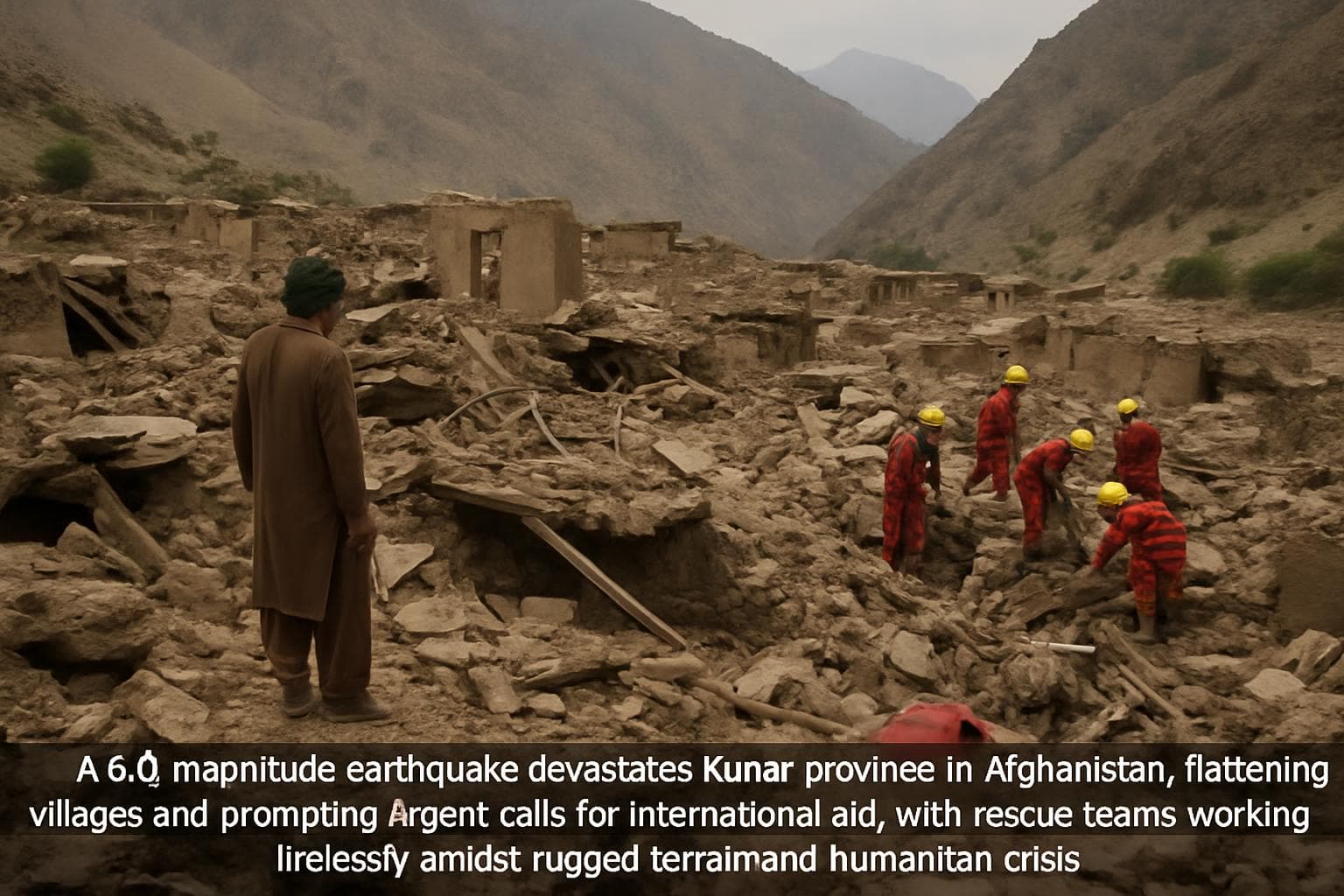
In the wake of a devastating 6.0-magnitude earthquake that struck eastern Afghanistan, the death toll has risen to over 900, with thousands more injured. The quake, which hit late Sunday night, has left a trail of destruction across Kunar province, a mountainous region bordering Pakistan. The Taliban have issued an urgent appeal for international aid to help manage the crisis.
Devastation in Kunar Province
The earthquake's epicenter was located near Jalalabad, Afghanistan's fifth-largest city, but the most severe impact was felt in Kunar province. Entire villages have been flattened, with homes made of mud and stone collapsing under the tremors. The rugged terrain and recent flooding have complicated rescue efforts, leaving many areas inaccessible. "Entire villages are flattened, roads to deep mountainous areas are still closed," a Taliban official stated, highlighting the challenges faced by rescue teams.
Rescue Efforts and Humanitarian Needs
Rescue operations are ongoing, with military teams and local villagers working tirelessly to reach those trapped under debris. Helicopters have been deployed to transport the injured to hospitals, but many survivors remain in dire need of medical assistance. "We need ambulances, we need doctors, we need everything to rescue the injured and recover the dead," one survivor pleaded. The Taliban's call for international aid underscores the country's limited resources, exacerbated by an existing economic crisis and reduced foreign assistance since their takeover in 2021.
A Nation in Crisis
Afghanistan is already grappling with severe economic challenges, compounded by a crippling withdrawal of international aid following the Taliban's rise to power. The earthquake has further strained the nation's resources, with the World Food Programme warning of an unprecedented hunger crisis. The disaster has also intensified the plight of Afghans recently deported from Iran and Pakistan, adding to the humanitarian burden.
WHAT THIS MIGHT MEAN
The immediate focus remains on rescue and relief operations, but the long-term implications of this disaster are significant. The Taliban's appeal for international aid could test diplomatic relations, potentially influencing future humanitarian assistance. Experts warn that without substantial international support, Afghanistan's recovery will be slow and arduous, further deepening the country's humanitarian crisis. As rescue teams continue to reach remote areas, the full extent of the devastation will become clearer, likely prompting further calls for global solidarity and aid.
Related Articles
Pakistan's Airstrikes on Afghanistan Escalate Cross-Border Tensions

Middle East Conflict Drives UK Energy Prices to New Highs
US and Israel Intensify Military Campaign as Iran's Capabilities Dwindle
UK Reinforces Military Presence in Cyprus Amid Middle East Tensions

US-Iran Tensions Escalate Amid Renewed Nuclear Talks and Protests

Canada and Australia Forge Strategic Partnership Amid Global Uncertainty
Afghanistan Earthquake: Over 900 Dead as Taliban Urge International Aid
In This Article
 James Okoro| Published
 HIGHLIGHTS
- A 6.0-magnitude earthquake in eastern Afghanistan has killed over 900 people, primarily in Kunar province.
- Thousands are injured, and the death toll is expected to rise as rescue teams reach remote areas.
- The Taliban have appealed for international aid to address the devastation and ongoing humanitarian crisis.
- Many survivors spent the night outdoors due to fear of aftershocks and damaged homes.
- Rescue efforts are hampered by rough terrain and recent flooding, complicating access to affected villages.
In the wake of a devastating 6.0-magnitude earthquake that struck eastern Afghanistan, the death toll has risen to over 900, with thousands more injured. The quake, which hit late Sunday night, has left a trail of destruction across Kunar province, a mountainous region bordering Pakistan. The Taliban have issued an urgent appeal for international aid to help manage the crisis.
Devastation in Kunar Province
The earthquake's epicenter was located near Jalalabad, Afghanistan's fifth-largest city, but the most severe impact was felt in Kunar province. Entire villages have been flattened, with homes made of mud and stone collapsing under the tremors. The rugged terrain and recent flooding have complicated rescue efforts, leaving many areas inaccessible. "Entire villages are flattened, roads to deep mountainous areas are still closed," a Taliban official stated, highlighting the challenges faced by rescue teams.
Rescue Efforts and Humanitarian Needs
Rescue operations are ongoing, with military teams and local villagers working tirelessly to reach those trapped under debris. Helicopters have been deployed to transport the injured to hospitals, but many survivors remain in dire need of medical assistance. "We need ambulances, we need doctors, we need everything to rescue the injured and recover the dead," one survivor pleaded. The Taliban's call for international aid underscores the country's limited resources, exacerbated by an existing economic crisis and reduced foreign assistance since their takeover in 2021.
A Nation in Crisis
Afghanistan is already grappling with severe economic challenges, compounded by a crippling withdrawal of international aid following the Taliban's rise to power. The earthquake has further strained the nation's resources, with the World Food Programme warning of an unprecedented hunger crisis. The disaster has also intensified the plight of Afghans recently deported from Iran and Pakistan, adding to the humanitarian burden.
WHAT THIS MIGHT MEAN
The immediate focus remains on rescue and relief operations, but the long-term implications of this disaster are significant. The Taliban's appeal for international aid could test diplomatic relations, potentially influencing future humanitarian assistance. Experts warn that without substantial international support, Afghanistan's recovery will be slow and arduous, further deepening the country's humanitarian crisis. As rescue teams continue to reach remote areas, the full extent of the devastation will become clearer, likely prompting further calls for global solidarity and aid.
Related Articles
Pakistan's Airstrikes on Afghanistan Escalate Cross-Border Tensions
Middle East Conflict Drives UK Energy Prices to New Highs
US and Israel Intensify Military Campaign as Iran's Capabilities Dwindle
UK Reinforces Military Presence in Cyprus Amid Middle East Tensions
US-Iran Tensions Escalate Amid Renewed Nuclear Talks and Protests
Canada and Australia Forge Strategic Partnership Amid Global Uncertainty