
Fragile Ceasefire in Gaza: Education Resumes Amidst Ongoing Air Strikes
In This Article
HIGHLIGHTS
- Children in Gaza return to makeshift schools after a two-year hiatus due to war, with over 97% of schools damaged.
- Israeli air strikes in Gaza have killed at least 13 people, including five children, despite a ceasefire in place.
- The fragile US-brokered ceasefire has seen frequent violations, with both Israel and Hamas accusing each other of breaches.
- The first phase of the US peace plan for Gaza has stalled, with disarmament and reconstruction efforts yet to progress.
- The humanitarian situation remains dire, with displaced families and disrupted education affecting thousands of children.
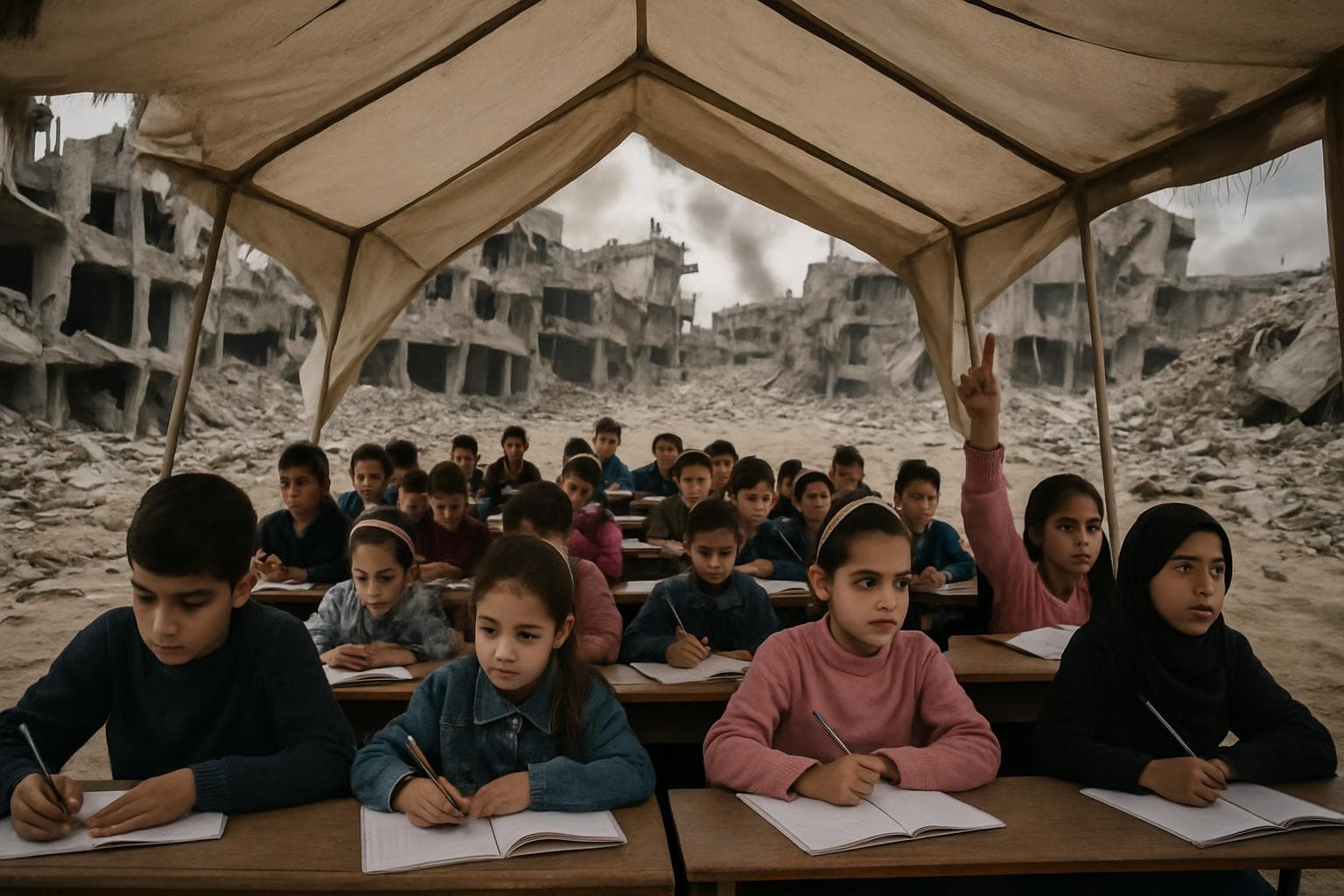
In the aftermath of a fragile ceasefire between Israel and Hamas, the sound of children learning has returned to Gaza, albeit under challenging conditions. Makeshift classrooms, set up in tents, have become the new norm for thousands of children who have been deprived of formal education for nearly two years due to the conflict. The Lulwa Abdel Wahab al-Qatami School in Gaza City, once a shelter for displaced families, now serves as a beacon of hope for education, despite its rudimentary setup.
According to UNICEF, over 97% of schools in Gaza were damaged or destroyed during the war, leaving the majority of the Strip's 658,000 school-aged children without formal education. Fourteen-year-old Naeem al-Asmaar, who lost his mother in an Israeli air strike, expressed the importance of returning to school, even if it means studying in tents. "School fills all my time and I really needed that," he shared.
Meanwhile, the ceasefire, brokered by the US on October 10, remains tenuous. Despite the truce, Israeli air strikes have continued, with Gaza's civil defence agency reporting at least 13 fatalities, including five children, in recent attacks. The strikes have been attributed to alleged ceasefire violations by both sides, with Israel and Hamas each accusing the other of breaching the agreement.
The US peace plan, which aims to disarm Hamas and initiate Gaza's reconstruction, has stalled. The plan's first phase, which included the release of hostages, has been completed, but further progress remains elusive. Critics argue that Israeli Prime Minister Benjamin Netanyahu may delay the process, seeking Hamas's disarmament before any withdrawal of Israeli troops.
As the humanitarian crisis persists, the makeshift schools run by UNICEF offer a glimmer of normalcy for Gaza's children. Dr. Mohammed Saeed Schheiber, the principal of the temporary school, emphasized the determination to compensate students for lost time, despite the limited curriculum focusing only on basic subjects.
WHAT THIS MIGHT MEAN
The ongoing ceasefire violations and stalled peace plan raise concerns about the future stability of the region. If the ceasefire collapses, it could lead to renewed hostilities, further endangering civilians and disrupting the fragile educational efforts. Experts suggest that international pressure may be necessary to ensure compliance with the ceasefire and to advance the peace plan's objectives.
The humanitarian situation in Gaza remains dire, with displaced families and disrupted education affecting thousands of children. The international community's role in facilitating reconstruction and supporting educational initiatives will be crucial in preventing a further deterioration of living conditions in the region.
As the situation unfolds, the potential for a political resolution remains uncertain. The success of the US peace plan hinges on mutual cooperation and trust, which are currently in short supply. Without significant progress, the cycle of violence and instability may continue to plague Gaza and its people.
Related Articles
Intensified US-Israel Strikes on Iran Spark Global Outcry

Middle East Conflict Drives UK Energy Prices to New Highs
US and Israel Intensify Military Campaign as Iran's Capabilities Dwindle
Israeli Airstrikes in Lebanon's Bekaa Valley Leave 10 Dead Amid Rising Tensions

Canada and Australia Forge Strategic Partnership Amid Global Uncertainty

Tech Giants Pledge to Cover AI Data Center Energy Costs Amid Rising Electricity Concerns
Fragile Ceasefire in Gaza: Education Resumes Amidst Ongoing Air Strikes
In This Article
 Aya Nakamura| Published
 HIGHLIGHTS
- Children in Gaza return to makeshift schools after a two-year hiatus due to war, with over 97% of schools damaged.
- Israeli air strikes in Gaza have killed at least 13 people, including five children, despite a ceasefire in place.
- The fragile US-brokered ceasefire has seen frequent violations, with both Israel and Hamas accusing each other of breaches.
- The first phase of the US peace plan for Gaza has stalled, with disarmament and reconstruction efforts yet to progress.
- The humanitarian situation remains dire, with displaced families and disrupted education affecting thousands of children.
In the aftermath of a fragile ceasefire between Israel and Hamas, the sound of children learning has returned to Gaza, albeit under challenging conditions. Makeshift classrooms, set up in tents, have become the new norm for thousands of children who have been deprived of formal education for nearly two years due to the conflict. The Lulwa Abdel Wahab al-Qatami School in Gaza City, once a shelter for displaced families, now serves as a beacon of hope for education, despite its rudimentary setup.
According to UNICEF, over 97% of schools in Gaza were damaged or destroyed during the war, leaving the majority of the Strip's 658,000 school-aged children without formal education. Fourteen-year-old Naeem al-Asmaar, who lost his mother in an Israeli air strike, expressed the importance of returning to school, even if it means studying in tents. "School fills all my time and I really needed that," he shared.
Meanwhile, the ceasefire, brokered by the US on October 10, remains tenuous. Despite the truce, Israeli air strikes have continued, with Gaza's civil defence agency reporting at least 13 fatalities, including five children, in recent attacks. The strikes have been attributed to alleged ceasefire violations by both sides, with Israel and Hamas each accusing the other of breaching the agreement.
The US peace plan, which aims to disarm Hamas and initiate Gaza's reconstruction, has stalled. The plan's first phase, which included the release of hostages, has been completed, but further progress remains elusive. Critics argue that Israeli Prime Minister Benjamin Netanyahu may delay the process, seeking Hamas's disarmament before any withdrawal of Israeli troops.
As the humanitarian crisis persists, the makeshift schools run by UNICEF offer a glimmer of normalcy for Gaza's children. Dr. Mohammed Saeed Schheiber, the principal of the temporary school, emphasized the determination to compensate students for lost time, despite the limited curriculum focusing only on basic subjects.
WHAT THIS MIGHT MEAN
The ongoing ceasefire violations and stalled peace plan raise concerns about the future stability of the region. If the ceasefire collapses, it could lead to renewed hostilities, further endangering civilians and disrupting the fragile educational efforts. Experts suggest that international pressure may be necessary to ensure compliance with the ceasefire and to advance the peace plan's objectives.
The humanitarian situation in Gaza remains dire, with displaced families and disrupted education affecting thousands of children. The international community's role in facilitating reconstruction and supporting educational initiatives will be crucial in preventing a further deterioration of living conditions in the region.
As the situation unfolds, the potential for a political resolution remains uncertain. The success of the US peace plan hinges on mutual cooperation and trust, which are currently in short supply. Without significant progress, the cycle of violence and instability may continue to plague Gaza and its people.
Related Articles
Intensified US-Israel Strikes on Iran Spark Global Outcry
Middle East Conflict Drives UK Energy Prices to New Highs
US and Israel Intensify Military Campaign as Iran's Capabilities Dwindle
Israeli Airstrikes in Lebanon's Bekaa Valley Leave 10 Dead Amid Rising Tensions
Canada and Australia Forge Strategic Partnership Amid Global Uncertainty
Tech Giants Pledge to Cover AI Data Center Energy Costs Amid Rising Electricity Concerns