
Innovative Farming Techniques Aim to Balance Livestock and Climate Goals
In This Article
HIGHLIGHTS
- Johnnie Balfour's farm in Fife is carbon negative, offsetting emissions through efficient grazing and natural offsets like trees and soil.
- The Scottish government aims for net zero by 2045, but current policies conflict with the Climate Change Committee's advice to reduce livestock.
- New technology, such as electric collars and virtual fencing, is helping farmers manage livestock more efficiently and support habitat restoration.
- The use of virtual fencing can eliminate the need for physical barriers, aiding in environmental conservation efforts.
- The Scottish government's decision not to reduce livestock numbers has significant implications for meeting carbon reduction targets.
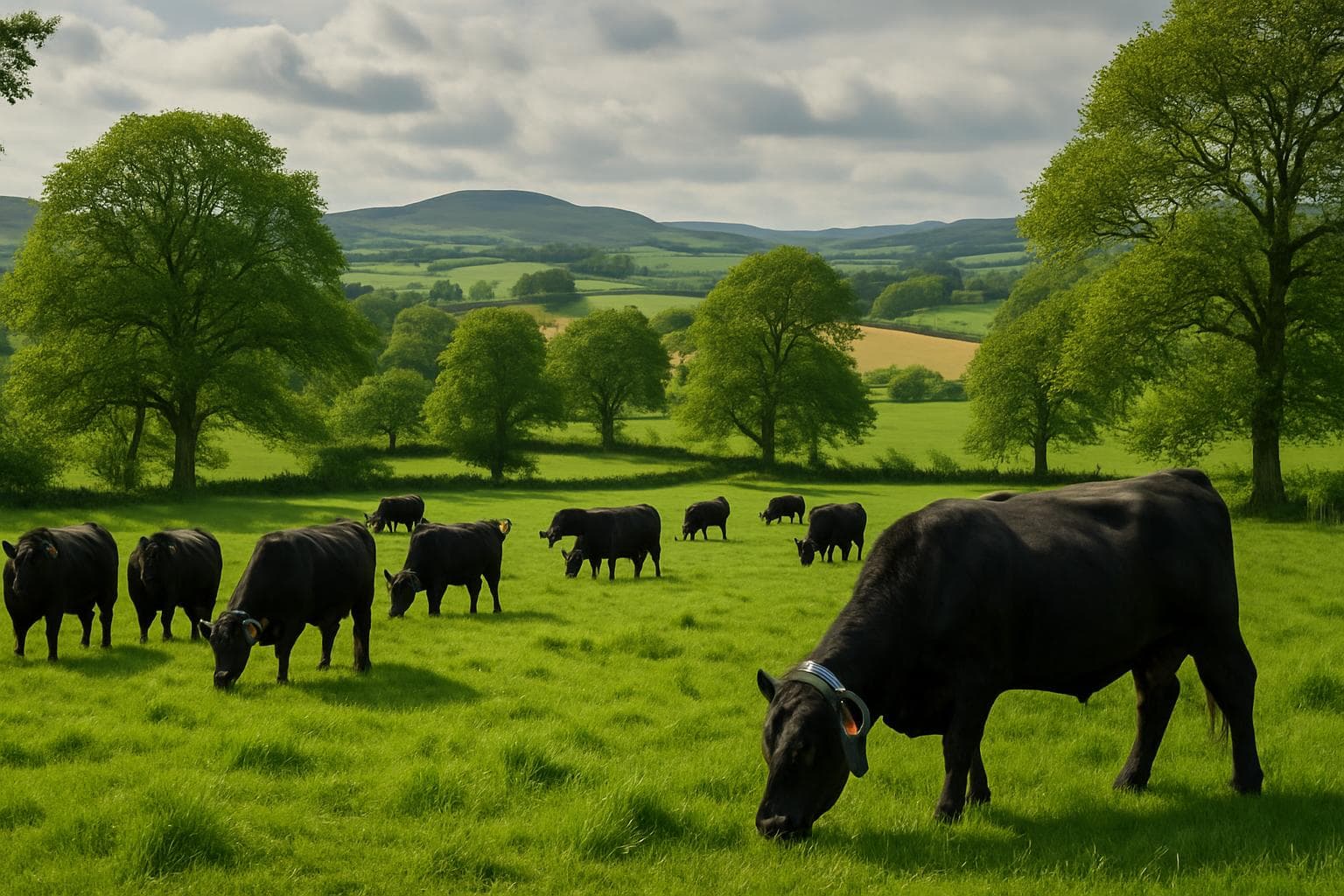
In the rolling hills of Fife, Scotland, farmer Johnnie Balfour is challenging conventional wisdom about livestock farming's environmental impact. His 300-strong herd of Aberdeen Angus cattle, known for their methane emissions, are part of a carbon-negative operation. Balfour's farm removes more carbon dioxide from the atmosphere than it emits, thanks to efficient grazing practices and natural offsets like trees and soil.
Balfour employs mob grazing, a method where cattle are moved to fresh pasture daily, allowing the land to recover and sequester carbon effectively. "It's not the cow, it's the how," Balfour asserts, emphasizing the importance of farm management over simply reducing livestock numbers. His approach aligns with the Scottish government's vision for sustainable land use by 2045, aiming for net zero emissions.
However, the path to net zero is fraught with challenges. The Scottish government recently abandoned annual carbon targets in favor of five-year budgets, yet their promise not to cut livestock numbers contradicts the Climate Change Committee's recommendation of a 26% reduction by 2035. This decision could hinder efforts to decrease agricultural emissions from 7.6 million tonnes in 2025 to 5.1 million by 2035.
Meanwhile, technological advancements are transforming farming practices. In a remote hill farm, electric collars equipped with GPS technology are revolutionizing livestock management. These collars allow farmers to track cattle locations via a phone app, saving time and effort, especially during winter months. The technology also supports habitat restoration through virtual fencing, guiding cattle to graze specific areas without physical barriers.
Such innovations offer promising solutions for balancing agricultural productivity with environmental conservation. As the Scottish government navigates its climate commitments, the integration of sustainable practices and technology will be crucial in achieving long-term goals.
WHAT THIS MIGHT MEAN
The Scottish government's decision to maintain livestock numbers could complicate its path to net zero, potentially requiring more aggressive measures in other sectors. Experts suggest that integrating technology like virtual fencing could mitigate some environmental impacts, but widespread adoption and investment are necessary. As policymakers and farmers collaborate, the focus will likely shift towards innovative solutions that balance economic viability with ecological responsibility. The coming years will test Scotland's ability to lead in sustainable agriculture while meeting its ambitious climate targets.
Related Articles

Hopeful Signs for Scotland's Endangered Capercaillie as Conservation Efforts Show Promise
UK's PFAS Action Plan Faces Criticism Amid Environmental Concerns
Solar Power Initiatives Transforming Communities and Energy Landscape in the UK

Saharan Dust to Illuminate UK Skies with Vivid Sunrises and Sunsets

Avalanche Risks Surge Amidst Extreme Weather Conditions in California and Europe

Peter Murrell Faces Embezzlement Charges Amid SNP Financial Probe
Innovative Farming Techniques Aim to Balance Livestock and Climate Goals
In This Article
 Leila Hassan| Published
 HIGHLIGHTS
- Johnnie Balfour's farm in Fife is carbon negative, offsetting emissions through efficient grazing and natural offsets like trees and soil.
- The Scottish government aims for net zero by 2045, but current policies conflict with the Climate Change Committee's advice to reduce livestock.
- New technology, such as electric collars and virtual fencing, is helping farmers manage livestock more efficiently and support habitat restoration.
- The use of virtual fencing can eliminate the need for physical barriers, aiding in environmental conservation efforts.
- The Scottish government's decision not to reduce livestock numbers has significant implications for meeting carbon reduction targets.
In the rolling hills of Fife, Scotland, farmer Johnnie Balfour is challenging conventional wisdom about livestock farming's environmental impact. His 300-strong herd of Aberdeen Angus cattle, known for their methane emissions, are part of a carbon-negative operation. Balfour's farm removes more carbon dioxide from the atmosphere than it emits, thanks to efficient grazing practices and natural offsets like trees and soil.
Balfour employs mob grazing, a method where cattle are moved to fresh pasture daily, allowing the land to recover and sequester carbon effectively. "It's not the cow, it's the how," Balfour asserts, emphasizing the importance of farm management over simply reducing livestock numbers. His approach aligns with the Scottish government's vision for sustainable land use by 2045, aiming for net zero emissions.
However, the path to net zero is fraught with challenges. The Scottish government recently abandoned annual carbon targets in favor of five-year budgets, yet their promise not to cut livestock numbers contradicts the Climate Change Committee's recommendation of a 26% reduction by 2035. This decision could hinder efforts to decrease agricultural emissions from 7.6 million tonnes in 2025 to 5.1 million by 2035.
Meanwhile, technological advancements are transforming farming practices. In a remote hill farm, electric collars equipped with GPS technology are revolutionizing livestock management. These collars allow farmers to track cattle locations via a phone app, saving time and effort, especially during winter months. The technology also supports habitat restoration through virtual fencing, guiding cattle to graze specific areas without physical barriers.
Such innovations offer promising solutions for balancing agricultural productivity with environmental conservation. As the Scottish government navigates its climate commitments, the integration of sustainable practices and technology will be crucial in achieving long-term goals.
WHAT THIS MIGHT MEAN
The Scottish government's decision to maintain livestock numbers could complicate its path to net zero, potentially requiring more aggressive measures in other sectors. Experts suggest that integrating technology like virtual fencing could mitigate some environmental impacts, but widespread adoption and investment are necessary. As policymakers and farmers collaborate, the focus will likely shift towards innovative solutions that balance economic viability with ecological responsibility. The coming years will test Scotland's ability to lead in sustainable agriculture while meeting its ambitious climate targets.
Related Articles
Hopeful Signs for Scotland's Endangered Capercaillie as Conservation Efforts Show Promise
UK's PFAS Action Plan Faces Criticism Amid Environmental Concerns
Solar Power Initiatives Transforming Communities and Energy Landscape in the UK
Saharan Dust to Illuminate UK Skies with Vivid Sunrises and Sunsets
Avalanche Risks Surge Amidst Extreme Weather Conditions in California and Europe
Peter Murrell Faces Embezzlement Charges Amid SNP Financial Probe