
Mark Carney Urges Middle Powers to Unite as Global Order Shifts
In This Article
HIGHLIGHTS
- Canadian Prime Minister Mark Carney declared the "old world order" is not returning, urging middle powers to unite at the World Economic Forum.
- Carney criticized the use of economic coercion by powerful nations, indirectly referencing US President Donald Trump's policies.
- The speech highlighted Canada's unwavering support for Greenland and Denmark amid US interest in Greenland.
- Carney emphasized that middle powers must collaborate to maintain influence in global politics.
- The speech precedes Trump's arrival in Davos, where tensions over Greenland and NATO are expected to escalate.
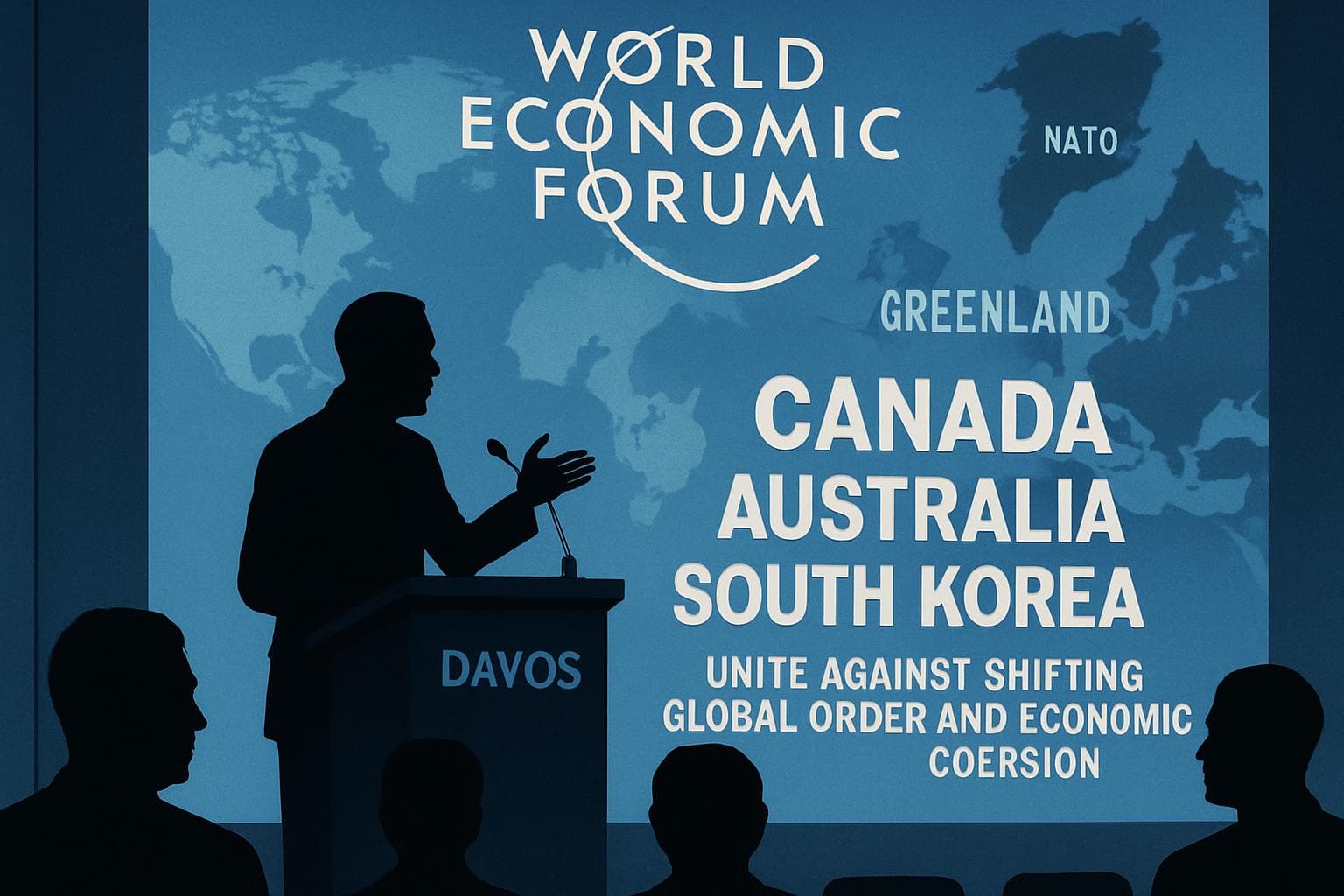
At the World Economic Forum in Davos, Canadian Prime Minister Mark Carney delivered a stark message: the "old world order" is not coming back. Addressing an audience of political and financial leaders, Carney emphasized the need for middle powers to collaborate in the face of growing economic coercion by great powers.
Middle Powers Must Unite
Carney's speech underscored the importance of middle powers—countries like Canada, Australia, and South Korea—acting collectively to safeguard their interests. "If we're not at the table, we're on the menu," he warned, highlighting the necessity for these nations to adapt to a new global reality marked by intensified great power rivalry.
Economic Coercion and Global Politics
Without naming US President Donald Trump, Carney criticized the use of economic integration as a tool of coercion, a tactic he attributed to powerful nations. This critique comes as Trump threatens tariffs on European allies and seeks to assert control over Greenland, a move that has strained transatlantic relations.
Canada's Stance on Greenland
Carney reaffirmed Canada's support for Greenland and Denmark, emphasizing the right of these territories to determine their own futures. As a NATO member, Canada stands firm in its commitment to collective security, a stance echoed by Canadian Foreign Minister Anita Anand, who confirmed Canada's participation in NATO exercises in the region.
Tensions at Davos
The speech sets the stage for Trump's arrival in Davos, where his ambitions regarding Greenland are expected to dominate discussions. European leaders, including French President Emmanuel Macron, have vowed to oppose Trump's aggressive policies, signaling a potential rift within the NATO alliance.
WHAT THIS MIGHT MEAN
The unfolding situation at Davos could have significant implications for global politics. If middle powers heed Carney's call to unite, they may form a more cohesive bloc capable of counterbalancing great power influence. However, Trump's continued pursuit of Greenland could exacerbate tensions within NATO, potentially leading to a reevaluation of alliances. Experts suggest that the outcome of these discussions may shape the future of international relations, particularly in terms of economic and military cooperation. As the world navigates this period of "rupture," the actions of both middle and great powers will be crucial in determining the new global order.
Related Articles
Canada Calls for De-escalation Amid US-Israel Strikes on Iran
China Sets Lowest GDP Growth Target in Decades Amid Economic Challenges
Canada and Australia Forge Strategic Partnership Amid Global Uncertainty
Tech Giants Pledge to Cover AI Data Center Energy Costs Amid Rising Electricity Concerns
Cuba Faces Widespread Blackout Amid Deepening Fuel Crisis

UK Faces Dilemmas Amid Iran Conflict and China Spying Allegations
Mark Carney Urges Middle Powers to Unite as Global Order Shifts
In This Article
 Daniel Rivera| Published
 HIGHLIGHTS
- Canadian Prime Minister Mark Carney declared the "old world order" is not returning, urging middle powers to unite at the World Economic Forum.
- Carney criticized the use of economic coercion by powerful nations, indirectly referencing US President Donald Trump's policies.
- The speech highlighted Canada's unwavering support for Greenland and Denmark amid US interest in Greenland.
- Carney emphasized that middle powers must collaborate to maintain influence in global politics.
- The speech precedes Trump's arrival in Davos, where tensions over Greenland and NATO are expected to escalate.
At the World Economic Forum in Davos, Canadian Prime Minister Mark Carney delivered a stark message: the "old world order" is not coming back. Addressing an audience of political and financial leaders, Carney emphasized the need for middle powers to collaborate in the face of growing economic coercion by great powers.
Middle Powers Must Unite
Carney's speech underscored the importance of middle powers—countries like Canada, Australia, and South Korea—acting collectively to safeguard their interests. "If we're not at the table, we're on the menu," he warned, highlighting the necessity for these nations to adapt to a new global reality marked by intensified great power rivalry.
Economic Coercion and Global Politics
Without naming US President Donald Trump, Carney criticized the use of economic integration as a tool of coercion, a tactic he attributed to powerful nations. This critique comes as Trump threatens tariffs on European allies and seeks to assert control over Greenland, a move that has strained transatlantic relations.
Canada's Stance on Greenland
Carney reaffirmed Canada's support for Greenland and Denmark, emphasizing the right of these territories to determine their own futures. As a NATO member, Canada stands firm in its commitment to collective security, a stance echoed by Canadian Foreign Minister Anita Anand, who confirmed Canada's participation in NATO exercises in the region.
Tensions at Davos
The speech sets the stage for Trump's arrival in Davos, where his ambitions regarding Greenland are expected to dominate discussions. European leaders, including French President Emmanuel Macron, have vowed to oppose Trump's aggressive policies, signaling a potential rift within the NATO alliance.
WHAT THIS MIGHT MEAN
The unfolding situation at Davos could have significant implications for global politics. If middle powers heed Carney's call to unite, they may form a more cohesive bloc capable of counterbalancing great power influence. However, Trump's continued pursuit of Greenland could exacerbate tensions within NATO, potentially leading to a reevaluation of alliances. Experts suggest that the outcome of these discussions may shape the future of international relations, particularly in terms of economic and military cooperation. As the world navigates this period of "rupture," the actions of both middle and great powers will be crucial in determining the new global order.
Related Articles
Canada Calls for De-escalation Amid US-Israel Strikes on Iran
China Sets Lowest GDP Growth Target in Decades Amid Economic Challenges
Canada and Australia Forge Strategic Partnership Amid Global Uncertainty
Tech Giants Pledge to Cover AI Data Center Energy Costs Amid Rising Electricity Concerns
Cuba Faces Widespread Blackout Amid Deepening Fuel Crisis
UK Faces Dilemmas Amid Iran Conflict and China Spying Allegations