
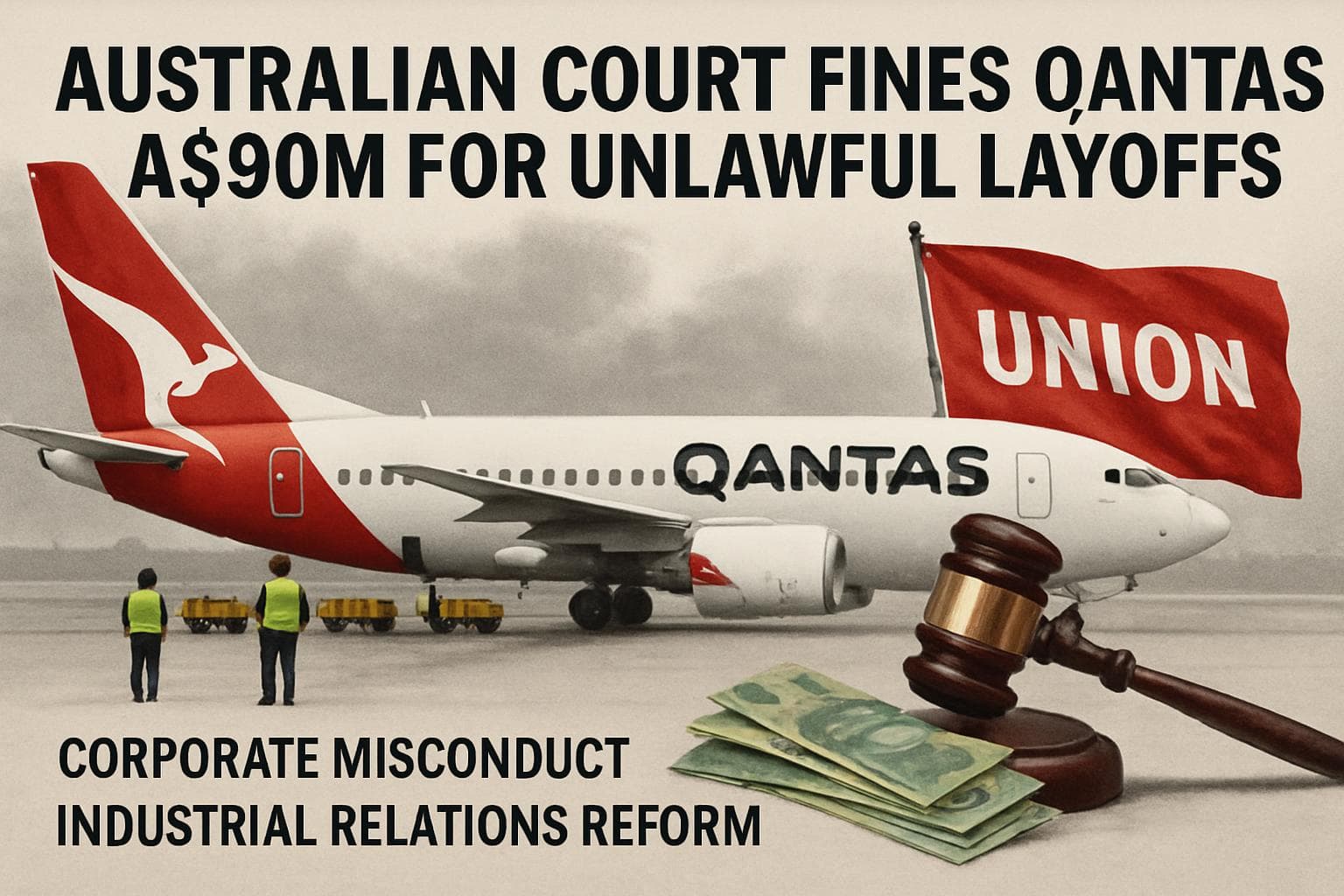
Qantas Faces Record A$90m Fine for Illegal Pandemic Layoffs
In This Article
HIGHLIGHTS
- Qantas has been fined a record A$90m for illegally sacking over 1,800 ground workers during the Covid-19 pandemic.
- The Federal Court ordered A$50m of the penalty to be paid to the Transport Workers' Union, which had sued Qantas over the layoffs.
- Justice Michael Lee criticized Qantas' corporate culture and questioned the sincerity of its remorse.
- The penalty is part of a larger A$210m cost, including A$120m in compensation agreed upon earlier.
- The case highlights potential gaps in the Fair Work Act and may prompt calls for increased penalties to deter similar corporate actions.
In a landmark ruling, Australia's Federal Court has imposed a record A$90m fine on Qantas for unlawfully terminating over 1,800 ground staff during the Covid-19 pandemic. This decision marks the largest penalty ever levied under the country's industrial relations laws, underscoring the serious repercussions of corporate misconduct.
Historic Penalty and Legal Battle
The court's decision comes after a protracted legal battle initiated by the Transport Workers' Union (TWU), which accused Qantas of breaching the Fair Work Act by outsourcing its ground operations in 2020. The airline justified the move as a financial necessity amidst the aviation industry's pandemic-induced downturn. However, Justice Michael Lee emphasized that the penalty should serve as a "real deterrence" to other employers contemplating similar actions.
Allocation of Penalty and Corporate Accountability
A significant portion of the fine, A$50m, is allocated to the TWU, a move Justice Lee believes will empower unions to enforce the Fair Work Act more effectively. The remaining A$40m allocation is yet to be decided. The ruling also includes A$120m in compensation that Qantas agreed to pay the affected workers, bringing the total cost of the outsourcing decision to over A$210m.
Criticism of Qantas' Corporate Culture
Justice Lee expressed skepticism about Qantas' expressions of remorse, describing the airline as "the wrong kind of sorry." He criticized the company's aggressive legal strategy and questioned the transparency of its decision-making process. The judge also noted the absence of testimony from Vanessa Hudson, Qantas' CEO, which could have clarified the airline's intentions and commitment to cultural change.
Implications for Industrial Relations
The case has sparked discussions about the adequacy of current penalties under the Fair Work Act. Legal experts, like Dan Trindade from Clayton Utz, suggest that the fine may not be sufficient to deter other companies from similar actions, potentially prompting calls for legislative reforms.
WHAT THIS MIGHT MEAN
The Qantas ruling could have significant implications for corporate governance and industrial relations in Australia. The substantial fine and public scrutiny may pressure other companies to reassess their employment practices, particularly during economic downturns. If the current penalties under the Fair Work Act are deemed insufficient, there may be legislative pushes to increase fines for breaches, ensuring stronger deterrents against unlawful corporate behavior. Additionally, the case highlights the critical role of unions in advocating for workers' rights, potentially leading to increased union involvement in similar disputes.
Images from the Web

Related Articles

Australia Bars IS-Linked Citizen from Returning Amidst Repatriation Debate

Canada and Australia Forge Strategic Partnership Amid Global Uncertainty

Israeli President Herzog's Visit to Australia Sparks Controversy Amid Calls for Unity

Canada Calls for De-escalation Amid US-Israel Strikes on Iran
Trump's New Tariff Strategy Sparks Global Trade Uncertainty
Trump Raises Import Tariffs to 15% After Supreme Court Setback
Qantas Faces Record A$90m Fine for Illegal Pandemic Layoffs
In This Article
HIGHLIGHTS
- Qantas has been fined a record A$90m for illegally sacking over 1,800 ground workers during the Covid-19 pandemic.
- The Federal Court ordered A$50m of the penalty to be paid to the Transport Workers' Union, which had sued Qantas over the layoffs.
- Justice Michael Lee criticized Qantas' corporate culture and questioned the sincerity of its remorse.
- The penalty is part of a larger A$210m cost, including A$120m in compensation agreed upon earlier.
- The case highlights potential gaps in the Fair Work Act and may prompt calls for increased penalties to deter similar corporate actions.
In a landmark ruling, Australia's Federal Court has imposed a record A$90m fine on Qantas for unlawfully terminating over 1,800 ground staff during the Covid-19 pandemic. This decision marks the largest penalty ever levied under the country's industrial relations laws, underscoring the serious repercussions of corporate misconduct.
Historic Penalty and Legal Battle
The court's decision comes after a protracted legal battle initiated by the Transport Workers' Union (TWU), which accused Qantas of breaching the Fair Work Act by outsourcing its ground operations in 2020. The airline justified the move as a financial necessity amidst the aviation industry's pandemic-induced downturn. However, Justice Michael Lee emphasized that the penalty should serve as a "real deterrence" to other employers contemplating similar actions.
Allocation of Penalty and Corporate Accountability
A significant portion of the fine, A$50m, is allocated to the TWU, a move Justice Lee believes will empower unions to enforce the Fair Work Act more effectively. The remaining A$40m allocation is yet to be decided. The ruling also includes A$120m in compensation that Qantas agreed to pay the affected workers, bringing the total cost of the outsourcing decision to over A$210m.
Criticism of Qantas' Corporate Culture
Justice Lee expressed skepticism about Qantas' expressions of remorse, describing the airline as "the wrong kind of sorry." He criticized the company's aggressive legal strategy and questioned the transparency of its decision-making process. The judge also noted the absence of testimony from Vanessa Hudson, Qantas' CEO, which could have clarified the airline's intentions and commitment to cultural change.
Implications for Industrial Relations
The case has sparked discussions about the adequacy of current penalties under the Fair Work Act. Legal experts, like Dan Trindade from Clayton Utz, suggest that the fine may not be sufficient to deter other companies from similar actions, potentially prompting calls for legislative reforms.
WHAT THIS MIGHT MEAN
The Qantas ruling could have significant implications for corporate governance and industrial relations in Australia. The substantial fine and public scrutiny may pressure other companies to reassess their employment practices, particularly during economic downturns. If the current penalties under the Fair Work Act are deemed insufficient, there may be legislative pushes to increase fines for breaches, ensuring stronger deterrents against unlawful corporate behavior. Additionally, the case highlights the critical role of unions in advocating for workers' rights, potentially leading to increased union involvement in similar disputes.
Images from the Web
Related Articles
Australia Bars IS-Linked Citizen from Returning Amidst Repatriation Debate
Canada and Australia Forge Strategic Partnership Amid Global Uncertainty
Israeli President Herzog's Visit to Australia Sparks Controversy Amid Calls for Unity
Canada Calls for De-escalation Amid US-Israel Strikes on Iran
Trump's New Tariff Strategy Sparks Global Trade Uncertainty
Trump Raises Import Tariffs to 15% After Supreme Court Setback