
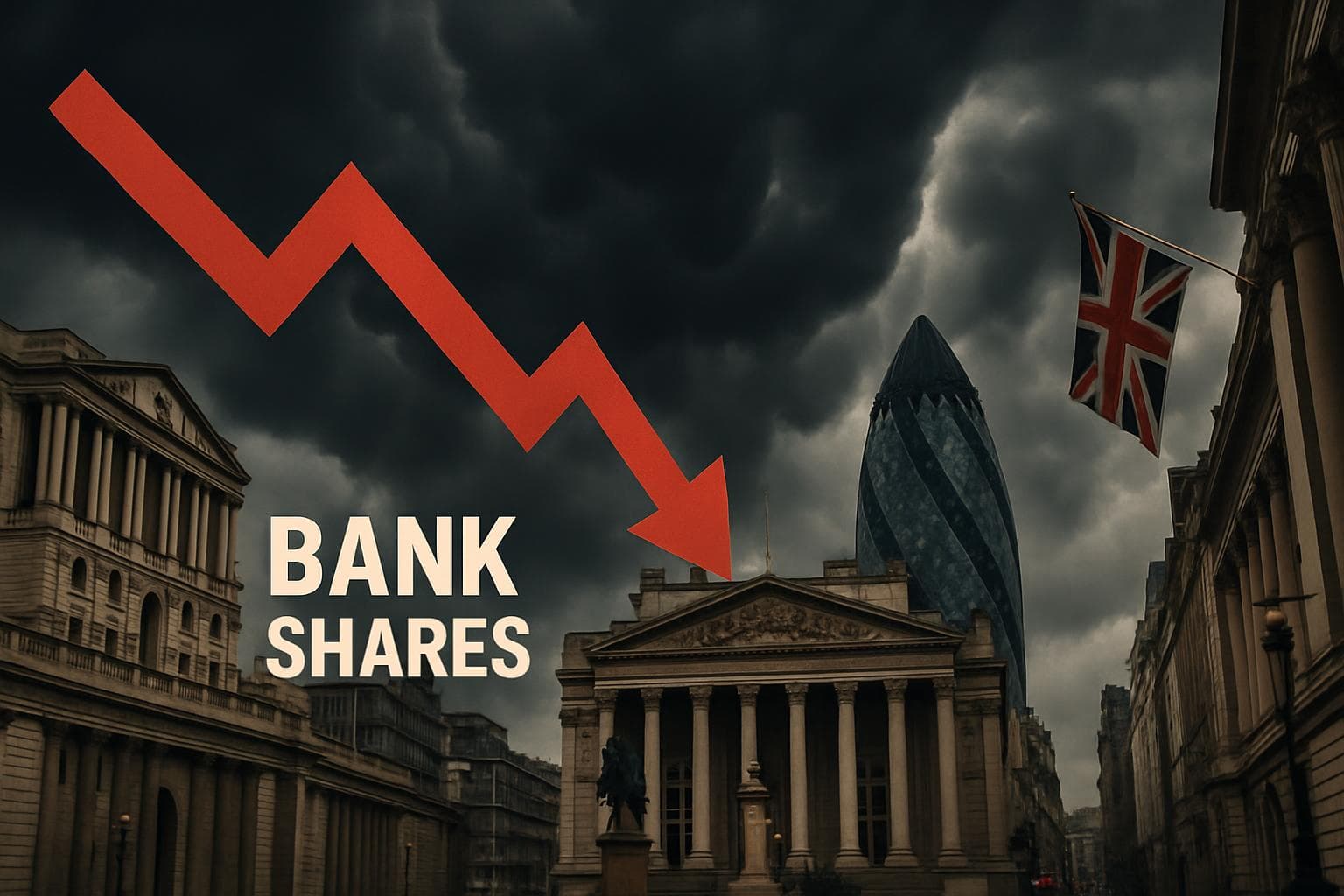
UK Bank Shares Plummet Amid Windfall Tax Proposal
In This Article
HIGHLIGHTS
- UK bank shares fell sharply, wiping £6.4bn off their market value, amid calls for a windfall tax on banking profits.
- The Institute for Public Policy Research (IPPR) proposed the tax to recover funds lost due to the Bank of England's quantitative easing.
- NatWest, Lloyds, and Barclays saw significant share price drops, with NatWest down nearly 5%.
- The IPPR argues the tax could generate £8bn annually, addressing public finance shortfalls.
- Critics warn that such a tax could conflict with the government's pro-growth financial strategy.
The share prices of major UK banks experienced a significant downturn on Friday following renewed calls for a windfall tax on banking profits. This proposal, put forward by the Institute for Public Policy Research (IPPR), suggests that the government could raise up to £8 billion annually by taxing the profits of large lenders. The IPPR argues that this measure is necessary to recoup taxpayer money lost due to the Bank of England's quantitative easing (QE) program.
The market reacted swiftly to the IPPR's report, with NatWest, Lloyds, and Barclays among the hardest hit. NatWest's shares fell nearly 5%, while Lloyds and Barclays saw declines of over 3% and 2%, respectively. The combined market value of these banks dropped by approximately £6.4 billion.
The Case for a Windfall Tax
The IPPR's proposal comes as Chancellor Rachel Reeves grapples with a potential £40 billion shortfall in public finances. The think tank contends that the QE program, initiated after the 2008 financial crisis, has inadvertently funneled public money into commercial banks. The Bank of England's purchase of £895 billion in bonds from banks resulted in reserves that now accrue interest at the central bank's base rate, currently 4%. This has led to a £22 billion annual loss for public finances.
Carsten Jung, associate director for economic policy at the IPPR, criticized the implementation of QE, stating, "Public money is flowing straight into commercial banks' coffers because of a flawed policy design." The IPPR suggests that a new bank levy, similar to a tax introduced by Margaret Thatcher in 1981, could help recover these funds and support the broader economy.
Industry Concerns and Criticisms
Despite the IPPR's rationale, the proposal has faced criticism from industry experts. Charlie Nunn, CEO of Lloyds Bank, has previously expressed opposition to potential tax increases, arguing that they would be inconsistent with efforts to bolster the UK economy. Neil Wilson, a strategist at Saxo Markets, echoed this sentiment, questioning whether such a tax aligns with a pro-growth agenda.
Richard Hunter, head of markets at Interactive Investor, warned that even the suggestion of a windfall tax could have an exaggerated impact, given the government's pressing need to raise income.
WHAT THIS MIGHT MEAN
Looking ahead, the proposal for a windfall tax on banks could have significant implications for the financial sector and the broader economy. If implemented, it may provide a much-needed boost to public finances but could also deter investment in the banking sector. The government faces a delicate balancing act between addressing fiscal shortfalls and maintaining a pro-growth economic strategy. As Chancellor Reeves prepares to outline her Budget strategy, the debate over the windfall tax is likely to intensify, with potential ramifications for both the banking industry and the UK's economic outlook.
Related Articles
Middle East Conflict Drives UK Energy Prices to New Highs
UK Achieves Record Budget Surplus Amid Calls for Fiscal Policy Reform
UK Inflation Drops to 3% in January, Sparking Interest Rate Cut Speculation

UK Government to Reform Asylum Seeker Support and Employment Policies

Breakthrough Drug Offers Hope for Children with Severe Epilepsy
Trump Raises Import Tariffs to 15% After Supreme Court Setback
UK Bank Shares Plummet Amid Windfall Tax Proposal
In This Article
 Daniel Rivera| Published
 HIGHLIGHTS
- UK bank shares fell sharply, wiping £6.4bn off their market value, amid calls for a windfall tax on banking profits.
- The Institute for Public Policy Research (IPPR) proposed the tax to recover funds lost due to the Bank of England's quantitative easing.
- NatWest, Lloyds, and Barclays saw significant share price drops, with NatWest down nearly 5%.
- The IPPR argues the tax could generate £8bn annually, addressing public finance shortfalls.
- Critics warn that such a tax could conflict with the government's pro-growth financial strategy.
The share prices of major UK banks experienced a significant downturn on Friday following renewed calls for a windfall tax on banking profits. This proposal, put forward by the Institute for Public Policy Research (IPPR), suggests that the government could raise up to £8 billion annually by taxing the profits of large lenders. The IPPR argues that this measure is necessary to recoup taxpayer money lost due to the Bank of England's quantitative easing (QE) program.
The market reacted swiftly to the IPPR's report, with NatWest, Lloyds, and Barclays among the hardest hit. NatWest's shares fell nearly 5%, while Lloyds and Barclays saw declines of over 3% and 2%, respectively. The combined market value of these banks dropped by approximately £6.4 billion.
The Case for a Windfall Tax
The IPPR's proposal comes as Chancellor Rachel Reeves grapples with a potential £40 billion shortfall in public finances. The think tank contends that the QE program, initiated after the 2008 financial crisis, has inadvertently funneled public money into commercial banks. The Bank of England's purchase of £895 billion in bonds from banks resulted in reserves that now accrue interest at the central bank's base rate, currently 4%. This has led to a £22 billion annual loss for public finances.
Carsten Jung, associate director for economic policy at the IPPR, criticized the implementation of QE, stating, "Public money is flowing straight into commercial banks' coffers because of a flawed policy design." The IPPR suggests that a new bank levy, similar to a tax introduced by Margaret Thatcher in 1981, could help recover these funds and support the broader economy.
Industry Concerns and Criticisms
Despite the IPPR's rationale, the proposal has faced criticism from industry experts. Charlie Nunn, CEO of Lloyds Bank, has previously expressed opposition to potential tax increases, arguing that they would be inconsistent with efforts to bolster the UK economy. Neil Wilson, a strategist at Saxo Markets, echoed this sentiment, questioning whether such a tax aligns with a pro-growth agenda.
Richard Hunter, head of markets at Interactive Investor, warned that even the suggestion of a windfall tax could have an exaggerated impact, given the government's pressing need to raise income.
WHAT THIS MIGHT MEAN
Looking ahead, the proposal for a windfall tax on banks could have significant implications for the financial sector and the broader economy. If implemented, it may provide a much-needed boost to public finances but could also deter investment in the banking sector. The government faces a delicate balancing act between addressing fiscal shortfalls and maintaining a pro-growth economic strategy. As Chancellor Reeves prepares to outline her Budget strategy, the debate over the windfall tax is likely to intensify, with potential ramifications for both the banking industry and the UK's economic outlook.
Related Articles
Middle East Conflict Drives UK Energy Prices to New Highs
UK Achieves Record Budget Surplus Amid Calls for Fiscal Policy Reform
UK Inflation Drops to 3% in January, Sparking Interest Rate Cut Speculation
UK Government to Reform Asylum Seeker Support and Employment Policies
Breakthrough Drug Offers Hope for Children with Severe Epilepsy
Trump Raises Import Tariffs to 15% After Supreme Court Setback