
Tragedy Strikes as Crane Collapse Derails Train in Thailand
In This Article
HIGHLIGHTS
- At least 22 people died and over 80 were injured when a crane collapsed onto a train in Nakhon Ratchasima, Thailand.
- The accident occurred at a construction site for a $5.4 billion high-speed rail project, part of China's Belt and Road Initiative.
- The train, traveling from Bangkok to Ubon Ratchathani, derailed and caught fire after being struck by a concrete segment.
- Emergency responders faced challenges due to a chemical leak at the scene, complicating rescue efforts.
- Safety regulation lapses are common in Thailand, contributing to frequent industrial accidents.
A devastating accident in Thailand's Nakhon Ratchasima province has claimed the lives of at least 22 people and injured over 80 others after a construction crane collapsed onto a moving passenger train. The incident, which occurred around 9:00 AM local time, has raised concerns about safety standards at construction sites across the country.
Accident Details and Immediate Response
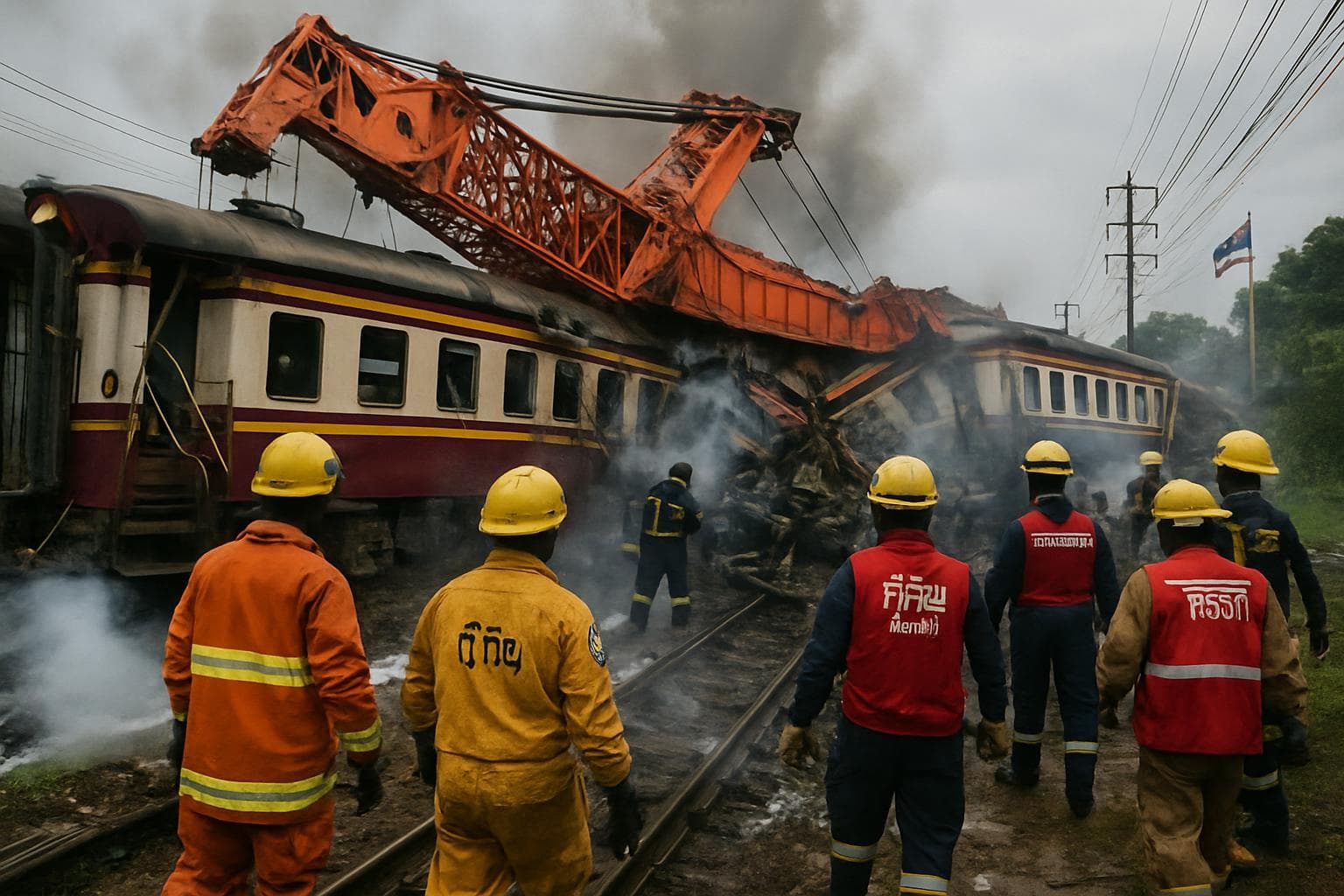
The train, carrying 195 passengers from Bangkok to Ubon Ratchathani, was traveling at approximately 120 km/h when it was struck by a large concrete segment dropped by the crane. The impact caused the train to derail and catch fire, with the second carriage suffering the most damage. Eyewitness Mitr Intrpanya described hearing a loud noise followed by explosions, and seeing the crane resting on the train's carriages.
Emergency responders, faced with the challenge of a chemical leak at the scene, worked tirelessly to rescue trapped passengers. Hydraulic cutters were employed to free individuals from the wreckage, while six critically injured passengers were transferred to other hospitals for urgent care.
Construction Site and Safety Concerns
The accident site is part of a $5.4 billion high-speed rail project, a key component of China's Belt and Road Initiative aimed at connecting Bangkok to Kunming in China by 2028. This project underscores Thailand's ambition to modernize its aging railway infrastructure, which spans approximately 5,000 km.
However, the tragedy has highlighted ongoing issues with safety regulation enforcement in Thailand. Industrial accidents are not uncommon, with previous incidents drawing attention to the need for stricter oversight and compliance with safety standards.
Official Reactions and Investigations
Transport Minister Phiphat Ratchakitprakarn has ordered a thorough investigation into the cause of the accident, emphasizing the need to identify the deceased and assess the condition of the injured. District police chief Thatchapon Chinnawong confirmed the death toll and the number of injured, while local authorities paused rescue operations due to the chemical hazard.
WHAT THIS MIGHT MEAN
The tragic crane collapse in Nakhon Ratchasima could prompt a reevaluation of safety protocols at construction sites across Thailand, particularly those involved in large-scale infrastructure projects like the high-speed rail network. The incident may lead to increased scrutiny of the Belt and Road Initiative's implementation in the region, potentially affecting timelines and project management strategies.
Politically, the accident could pressure Thai authorities to enhance regulatory frameworks and enforcement mechanisms to prevent future tragedies. Experts may call for comprehensive safety audits and the adoption of international best practices to safeguard both workers and the public. As investigations unfold, the findings could influence policy changes and drive reforms in Thailand's construction and transportation sectors.
Related Articles

Peru's Political Turmoil: President José Jerí Ousted Amid Scandal

US Supreme Court Ruling Sparks Trade Uncertainty in Asia and Beyond

Trump's New Tariff Strategy Sparks Global Trade Uncertainty

Trump's Tariff Strategy Faces Supreme Court Setback, New Measures Announced

Trump's Tariff Strategy Faces Supreme Court Setback, Sparks New Trade Policy

German Chancellor Warns of Eroding Global Order at Munich Security Conference
Tragedy Strikes as Crane Collapse Derails Train in Thailand
In This Article
 Ethan Brooks| Published
 HIGHLIGHTS
- At least 22 people died and over 80 were injured when a crane collapsed onto a train in Nakhon Ratchasima, Thailand.
- The accident occurred at a construction site for a $5.4 billion high-speed rail project, part of China's Belt and Road Initiative.
- The train, traveling from Bangkok to Ubon Ratchathani, derailed and caught fire after being struck by a concrete segment.
- Emergency responders faced challenges due to a chemical leak at the scene, complicating rescue efforts.
- Safety regulation lapses are common in Thailand, contributing to frequent industrial accidents.
A devastating accident in Thailand's Nakhon Ratchasima province has claimed the lives of at least 22 people and injured over 80 others after a construction crane collapsed onto a moving passenger train. The incident, which occurred around 9:00 AM local time, has raised concerns about safety standards at construction sites across the country.
Accident Details and Immediate Response
The train, carrying 195 passengers from Bangkok to Ubon Ratchathani, was traveling at approximately 120 km/h when it was struck by a large concrete segment dropped by the crane. The impact caused the train to derail and catch fire, with the second carriage suffering the most damage. Eyewitness Mitr Intrpanya described hearing a loud noise followed by explosions, and seeing the crane resting on the train's carriages.
Emergency responders, faced with the challenge of a chemical leak at the scene, worked tirelessly to rescue trapped passengers. Hydraulic cutters were employed to free individuals from the wreckage, while six critically injured passengers were transferred to other hospitals for urgent care.
Construction Site and Safety Concerns
The accident site is part of a $5.4 billion high-speed rail project, a key component of China's Belt and Road Initiative aimed at connecting Bangkok to Kunming in China by 2028. This project underscores Thailand's ambition to modernize its aging railway infrastructure, which spans approximately 5,000 km.
However, the tragedy has highlighted ongoing issues with safety regulation enforcement in Thailand. Industrial accidents are not uncommon, with previous incidents drawing attention to the need for stricter oversight and compliance with safety standards.
Official Reactions and Investigations
Transport Minister Phiphat Ratchakitprakarn has ordered a thorough investigation into the cause of the accident, emphasizing the need to identify the deceased and assess the condition of the injured. District police chief Thatchapon Chinnawong confirmed the death toll and the number of injured, while local authorities paused rescue operations due to the chemical hazard.
WHAT THIS MIGHT MEAN
The tragic crane collapse in Nakhon Ratchasima could prompt a reevaluation of safety protocols at construction sites across Thailand, particularly those involved in large-scale infrastructure projects like the high-speed rail network. The incident may lead to increased scrutiny of the Belt and Road Initiative's implementation in the region, potentially affecting timelines and project management strategies.
Politically, the accident could pressure Thai authorities to enhance regulatory frameworks and enforcement mechanisms to prevent future tragedies. Experts may call for comprehensive safety audits and the adoption of international best practices to safeguard both workers and the public. As investigations unfold, the findings could influence policy changes and drive reforms in Thailand's construction and transportation sectors.
Related Articles
Peru's Political Turmoil: President José Jerí Ousted Amid Scandal
US Supreme Court Ruling Sparks Trade Uncertainty in Asia and Beyond
Trump's New Tariff Strategy Sparks Global Trade Uncertainty
Trump's Tariff Strategy Faces Supreme Court Setback, New Measures Announced
Trump's Tariff Strategy Faces Supreme Court Setback, Sparks New Trade Policy
German Chancellor Warns of Eroding Global Order at Munich Security Conference