
Trump's Tariff Threats Escalate Tensions with Canada and EU
In This Article
HIGHLIGHTS
- President Donald Trump announced a 35% tariff on Canadian imports starting August 1, amid ongoing trade negotiations.
- Trump threatened additional tariffs of 15% or 20% on other trade partners, including the European Union.
- Canadian Prime Minister Mark Carney vowed to protect Canadian interests and continue negotiations with the US.
- The tariffs are linked to issues such as the fentanyl crisis and existing trade deficits, with potential adjustments based on Canada's cooperation.
- The US Court of Appeals is set to review the legality of Trump's tariff actions on July 31.
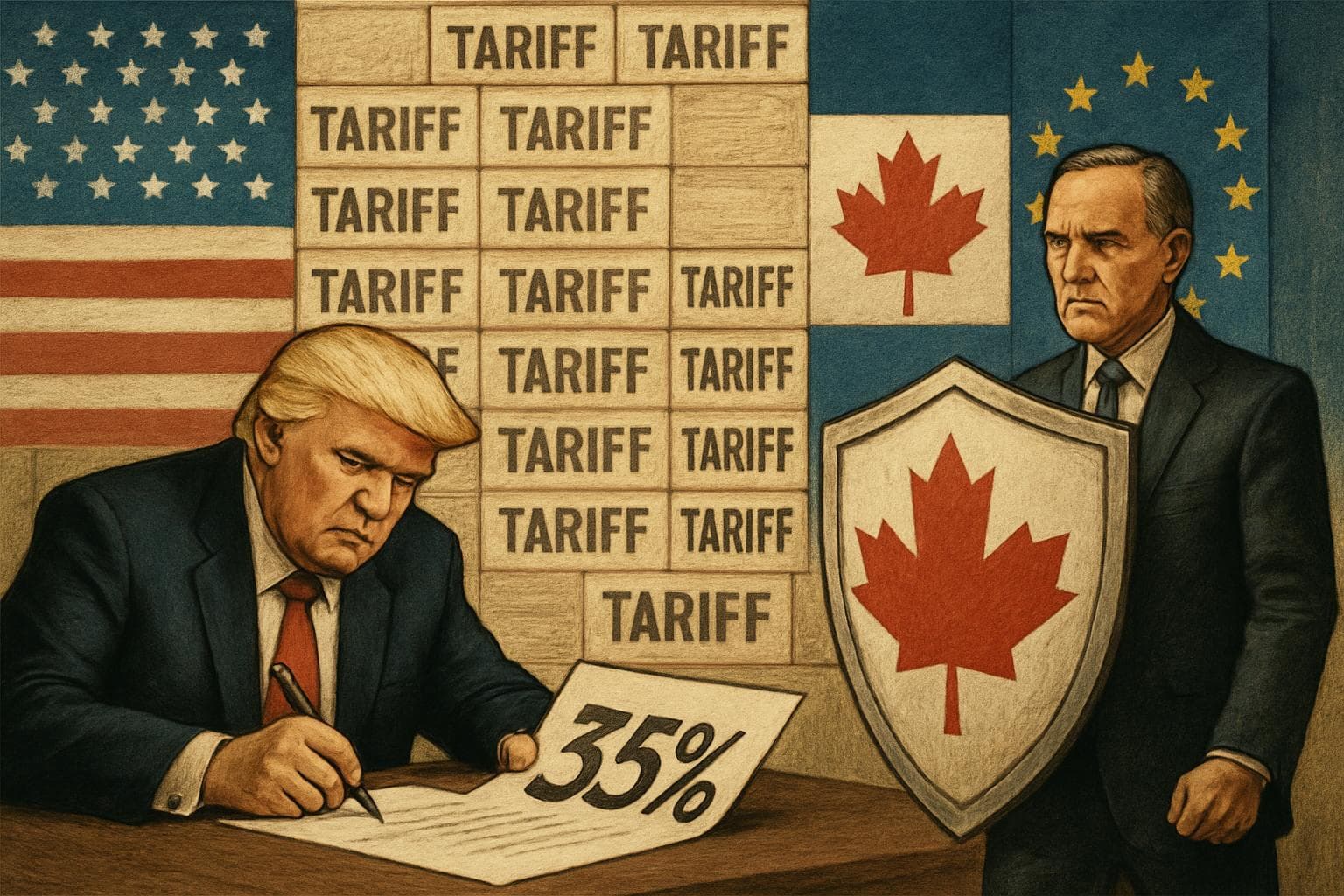
In a bold move that has intensified global trade tensions, US President Donald Trump announced a 35% tariff on Canadian imports, effective August 1. This decision, revealed in a letter on Trump's social media platform, Truth Social, comes as the US and Canada are locked in negotiations to reach a new trade agreement. The announcement also included threats of blanket tariffs of 15% or 20% on other trade partners, including the European Union.
Impact on Canada and Trade Negotiations
Canadian Prime Minister Mark Carney responded to Trump's announcement by affirming his government's commitment to defending Canadian workers and businesses. "We will continue to protect our interests as we work towards a resolution," Carney stated on X, formerly known as Twitter. The tariffs pose a significant challenge for Canada, which exports approximately three-quarters of its goods to the US, particularly in the auto manufacturing and metals sectors.
Link to Fentanyl Crisis and Trade Deficits
Trump's letter tied the tariffs to Canada's alleged failure to curb the flow of fentanyl into the US, as well as existing trade imbalances. "If Canada works with me to stop the flow of fentanyl, we will, perhaps, consider an adjustment to this letter," Trump wrote. The US Customs and Border Patrol data, however, indicates that only about 0.2% of fentanyl seizures occur at the Canadian border.
Legal and International Repercussions
The legality of Trump's tariff actions is under scrutiny, with a hearing scheduled at the US Court of Appeals on July 31. The court will review whether Trump exceeded his legal authority by imposing tariffs without an actual emergency. Meanwhile, the European Union and other trade partners remain on edge, awaiting potential tariff letters from the US.
Broader Trade War Context
This latest development is part of Trump's broader trade war strategy, which has seen more than 20 tariff-related letters issued to various countries this week. The United States-Mexico-Canada Agreement (USMCA), which replaced NAFTA in 2020, is also at risk as Canada and Mexico seek ways to satisfy US demands and maintain the agreement's integrity.
WHAT THIS MIGHT MEAN
The upcoming court ruling on July 31 could significantly impact Trump's ability to enforce these tariffs. If the court rules against him, it may halt the tariff increases and force a reevaluation of his trade strategy. Politically, these aggressive moves could strain US relations with key allies, potentially leading to retaliatory measures that further complicate international trade dynamics. Experts suggest that a resolution may require diplomatic negotiations addressing both trade imbalances and broader geopolitical concerns, such as the fentanyl crisis.
Related Articles
Canada and Australia Forge Strategic Partnership Amid Global Uncertainty
Canada Calls for De-escalation Amid US-Israel Strikes on Iran

Spain's Sánchez Stands Firm Against Trump's Trade Threat Over Iran Stance

Tech Giants Pledge to Cover AI Data Center Energy Costs Amid Rising Electricity Concerns

Congress Subpoenas Attorney General Bondi in Epstein Investigation

Cuba Faces Widespread Blackout Amid Deepening Fuel Crisis
Trump's Tariff Threats Escalate Tensions with Canada and EU
In This Article
HIGHLIGHTS
- President Donald Trump announced a 35% tariff on Canadian imports starting August 1, amid ongoing trade negotiations.
- Trump threatened additional tariffs of 15% or 20% on other trade partners, including the European Union.
- Canadian Prime Minister Mark Carney vowed to protect Canadian interests and continue negotiations with the US.
- The tariffs are linked to issues such as the fentanyl crisis and existing trade deficits, with potential adjustments based on Canada's cooperation.
- The US Court of Appeals is set to review the legality of Trump's tariff actions on July 31.
In a bold move that has intensified global trade tensions, US President Donald Trump announced a 35% tariff on Canadian imports, effective August 1. This decision, revealed in a letter on Trump's social media platform, Truth Social, comes as the US and Canada are locked in negotiations to reach a new trade agreement. The announcement also included threats of blanket tariffs of 15% or 20% on other trade partners, including the European Union.
Impact on Canada and Trade Negotiations
Canadian Prime Minister Mark Carney responded to Trump's announcement by affirming his government's commitment to defending Canadian workers and businesses. "We will continue to protect our interests as we work towards a resolution," Carney stated on X, formerly known as Twitter. The tariffs pose a significant challenge for Canada, which exports approximately three-quarters of its goods to the US, particularly in the auto manufacturing and metals sectors.
Link to Fentanyl Crisis and Trade Deficits
Trump's letter tied the tariffs to Canada's alleged failure to curb the flow of fentanyl into the US, as well as existing trade imbalances. "If Canada works with me to stop the flow of fentanyl, we will, perhaps, consider an adjustment to this letter," Trump wrote. The US Customs and Border Patrol data, however, indicates that only about 0.2% of fentanyl seizures occur at the Canadian border.
Legal and International Repercussions
The legality of Trump's tariff actions is under scrutiny, with a hearing scheduled at the US Court of Appeals on July 31. The court will review whether Trump exceeded his legal authority by imposing tariffs without an actual emergency. Meanwhile, the European Union and other trade partners remain on edge, awaiting potential tariff letters from the US.
Broader Trade War Context
This latest development is part of Trump's broader trade war strategy, which has seen more than 20 tariff-related letters issued to various countries this week. The United States-Mexico-Canada Agreement (USMCA), which replaced NAFTA in 2020, is also at risk as Canada and Mexico seek ways to satisfy US demands and maintain the agreement's integrity.
WHAT THIS MIGHT MEAN
The upcoming court ruling on July 31 could significantly impact Trump's ability to enforce these tariffs. If the court rules against him, it may halt the tariff increases and force a reevaluation of his trade strategy. Politically, these aggressive moves could strain US relations with key allies, potentially leading to retaliatory measures that further complicate international trade dynamics. Experts suggest that a resolution may require diplomatic negotiations addressing both trade imbalances and broader geopolitical concerns, such as the fentanyl crisis.
Related Articles
Canada and Australia Forge Strategic Partnership Amid Global Uncertainty
Canada Calls for De-escalation Amid US-Israel Strikes on Iran
Spain's Sánchez Stands Firm Against Trump's Trade Threat Over Iran Stance
Tech Giants Pledge to Cover AI Data Center Energy Costs Amid Rising Electricity Concerns
Congress Subpoenas Attorney General Bondi in Epstein Investigation
Cuba Faces Widespread Blackout Amid Deepening Fuel Crisis